2015 saw the release of a film that showcased what might be thought of as Jennifer Aniston’s most revealing and dramatic role. Ignoring the middling reviews allows an engagement with an understated and powerful performance and a chance for Aniston to take centre stage.
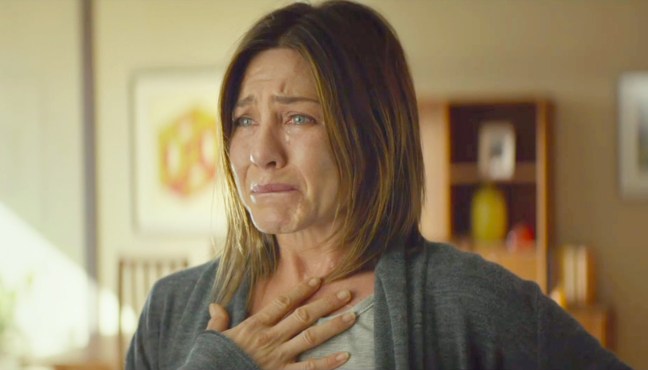
Aniston as Claire
FILM: Cake
DIRECTOR: Daniel Barnz
YEAR: 2014
CHARACTER NAME AND PROFESSION: Claire Bennett, former lawyer
PLOT SUMMARY: Claire is recovering from an accident that killed her young son and left her with chronic back pain, after having pins in her legs for a year. Divorced from her husband Jason (Chris Messina), she attends a support group, which she finds unhelpful, and relies largely on her carer Silvana (Adrianna Barraza) for companionship and support. Claire becomes fascinated by the suicide of another chronic pain sufferer, Nina (Anna Kendrick) and is haunted by visions of her.
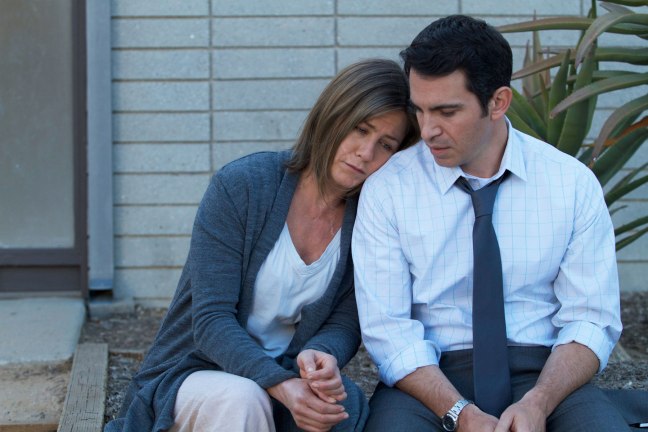
Aniston with Chris Messina as Jason
CHARACTER TRAITS: Resentful, pragmatic, insensitive, loyal, honest.
NOTES ON PERFORMANCE: Aniston here demonstrates astonishing control and command of her emotional range and physicality, portraying with a sense of hidden charisma, a person just holding on to the world. Cake presents a person affected by great tragedy, without labouring what it is Claire has lost, or the details of the person she was before it happened, and in her performance Aniston delves fully into the misery of all this, without giving the audience the respite of what a ‘nice’ person she might have been before.
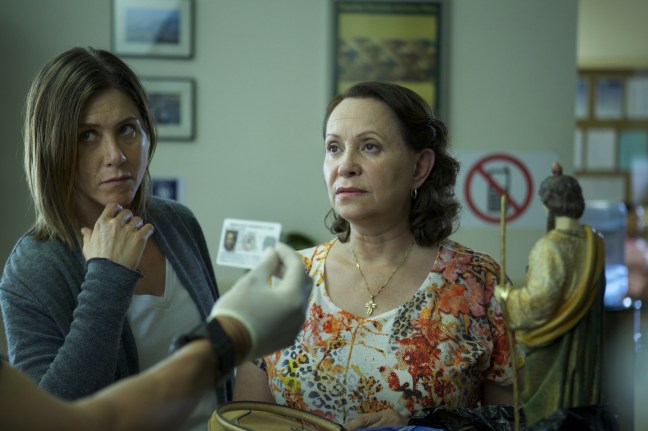
With Adrianna Barraza as Silvana
NOTES ON FILM: Cake should be celebrated for showcasing what Aniston is capable of when she’s given the chance to carry a film. Despite a preconception of such a grim subject as being awards-bait, the film is refreshing in that it allows Aniston to underplay, and is far from providing the kind of revelatory third act that most dramatic, bereavement related films might use. It would be very easy to critique Cake for what’s its not, instead of praising where it gets things right, for which Aniston’s performance is a factor that cannot be overstated enough. Barraza is also excellent, making Silvana a rounded character with her own motivations and life away from her role as carer. Cake is a hard sell, but when considered alongside the likes of Still Alice, or Clouds of Sils Maria, it’s demonstrable as one of 2015’s most accomplished pieces about a woman in middle-age, and a central performance that’s worth viewing alone.
CONCLUSION: Finally, it’s all about Aniston.
As the red curtains are soon to close on 2015, the impetus to catch up on films I’ve missed has set in. It’s also the time for ‘Best of’ lists and for my part I’ve already contributed to one – in early November I was asked to select my ‘preferred five films’ of 2015 for Sight & Sound magazine’s annual poll. Since then I’ve seen more that I would have included, but luckily the CineVue top ten will be revealed later this month, so those missed in S&S will get their chance. Of those in Sight & Sound’s top ten, I’ve seen eight (though only if you count joint eleventh position) but not their number one film, Hou Hsiao-Hsien’s The Assassin and only one is in my top five, David Robert Mitchell’s It Follows. You can read my full list and rationale behind my selection here.
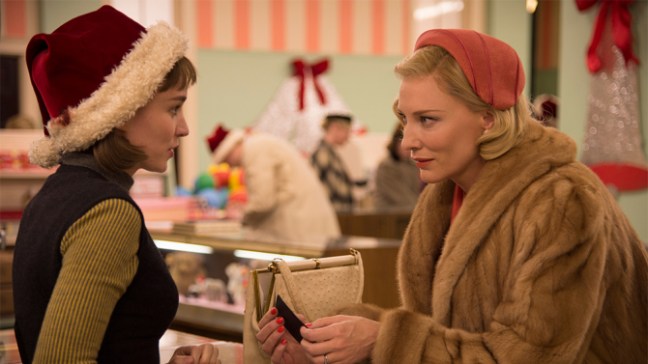
Rooney Mara as Therese and Cate Blanchett as Carol
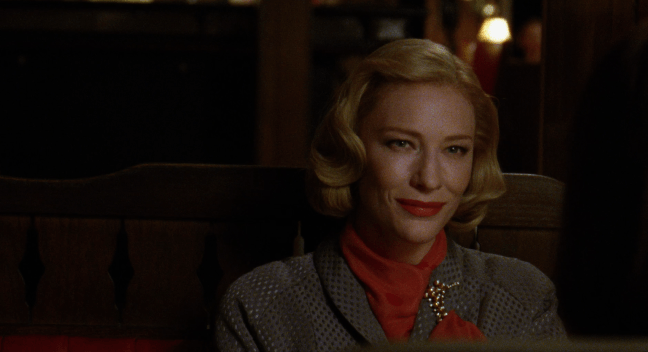
At the cinema meanwhile, there’s also been plenty to see. Todd Hayne’s Carol, starring Cate Blanchett in the eponymous role and Rooney Mara as shop clerk Therese, who fall in love in 1950’s New York, is perhaps one of the most accomplished and affecting works of cinema I’ve ever seen. Adapted by Phyllis Nagy from the 1953 novel The Price of Salt by Patricia Highsmith and shot on Super 16mm, Haynes has created a film so utterly glorious it’s hard to know where to begin praising it. Instead I’ll attempt to recall those moments that moved me so acutely. Both performances by Mara and Blanchett are fantastic. Blanchett demonstrates that Carol is first of all a mother, dedicated to her daughter Rindy (Sadie and Kk Heim) and possessed of a will strong enough to know that abandoning her identity would be more damaging than partial custody of Rindy. At the same time, her chemistry with Mara is palpable, showing their instant attraction and developing tenderness for one another.
Rooney Mara
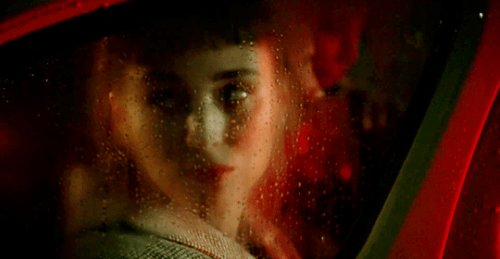
Mara as Therese reveals the agony – frequently internalised – of having no name for what she’s feeling, but becoming aware that her lack of investment in her heteronormative life might have an explanation that she can share with someone else. Carol shifts its narrative focus between Therese and Carol, demonstrating how they both experience a questioning of their identity, struggling with, by turns, the reconciliation of being a mother, but not a wife, or where one’s allies and friends might really lie. As with Far From Heaven (2002) Haynes recreates the 1950s’ period with a cinematic nostalgia that nods to the work of Douglas Sirk and the paintings of Edward Hopper and has even been open about stealing the opening scene’s set up from David Lean’s Brief Encounter (1945), where a hand on a shoulder is the only expression of affection permissible in public. The film’s identity theme is also expressed in the use of reflections, as the characters gaze into mirrors, or are seen through rain-soaked glass, or a camera’s lens. Here, love is about how one identifies not only with one’s lover, but with the image of oneself.
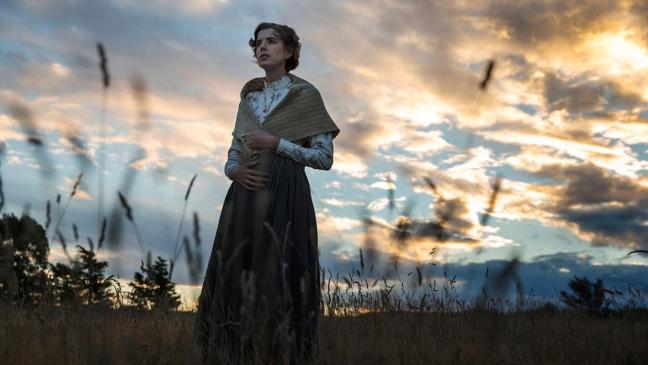
Agyness Deyn as Chris in Sunset Song
Also at the cinema, I rushed to see Terence Davies long-gestating adaptation of Lewis Grassic Gibbon’s 1932 novel, Sunset Song. Set in the years just before WWI, the film tells the story of Chris (Agyness Deyn), a young woman who lives with her family on their farm in rural Aberdeenshire. Throughout Sunset Song, Chris’s coming to terms with her own autonomy, her own desires and the responsibilities of motherhood allow Deyn the opportunity for a spirited and sensitive performance. Chris’s changes as a woman are compared to the mutability of the seasons, and cinematographer Michael McDonough’s choice of 65mm for the exterior scenes celebrate the drama and beauty of the landscape. Much like Davies’ Distant Voices, Still Lives (1988), an overbearing father is again a central element, yet the revelatory use of nature, opens up Sunset Song to a make it more than a set of explored themes for the director.
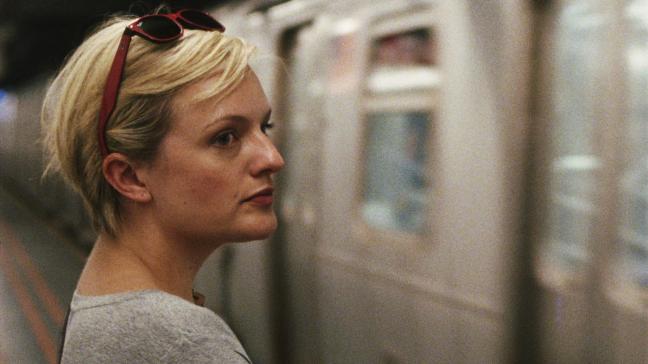
Elizabeth Moss as Ashley in Listen Up Philip
Other films viewed in an effort to ‘catch up’ include Olivier Assayas’ Clouds of Sils Maria, in which a luminous Juliette Binoche plays an actor facing up to aging, role reversal and the ‘truths’ of performance alongside a fantastic Kristen Stewart. A Pigeon Sat on a Bench Reflecting on Existence was the latest from Roy Andersson this year, which again follows Songs From the Second Floor (2000) and You, the Living (2007), in depicting the inherent tragi-comedy of modern life. I also checked out Listen Up Philip by Alex Ross Perry, a comedy about a total bastard novelist ‘struggling’ with success. The film says very little of any originality about the torment of creativity, but it does take an interesting route by spending almost as much time with Philip’s (Jason Schwartzman) ex, Ashley (Elizabeth Moss), and her development into a single person again contains some very thoughtful moments, not to mention a stunning performance by Moss
We’re six weeks into our Aniston investigation and it turns out there’s a lot of the nineties still to get through. With that in mind, we delve into what might be deemed half an Aniston, where our favourite Friend doesn’t get the screen time she deserves.
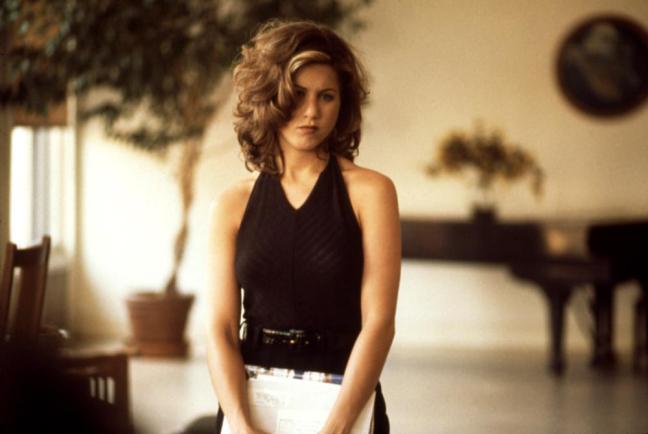
FILM: She’s the One DIRECTOR: Edward Burns YEAR: 1996
CHARACTER NAME AND PROFESSION: Renee, seemingly of no profession.
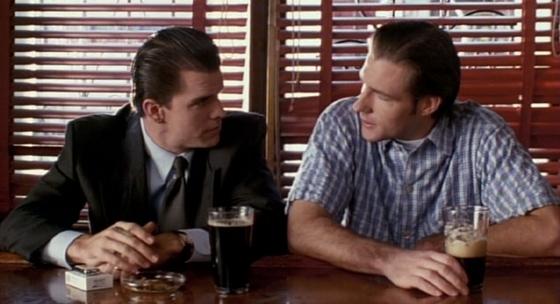
PLOT SUMMARY: Brothers Mickey (Edward Burns) and Francis (Michael McGlone) each have romantic ‘dilemmas’. Mickey recently returned from a three year trip he took to recover from breaking up with his fiancée Heather (Cameron Diaz), works as a cabbie and one day decides to marry a beautiful fare, named appropriately – Hope (Maxine Bahns) – when she asks him to drive her all the way to someone else’s wedding. Francis is a wall-street broker, married to Renee (Aniston), but having an affair with Heather. He berates Mickey constantly for not having financial success, despite being a miserable, cheating bastard. They take advice from their father, played by John Mahoney. So far, so nineties.
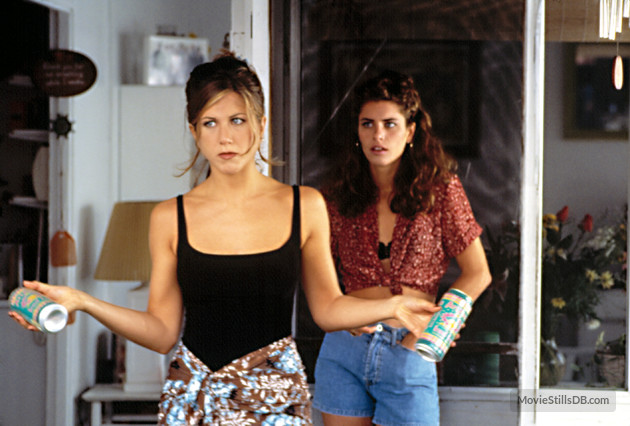
Aniston with Amanda Peet as Renee’s sister Molly
CHARACTER TRAITS: Renee is sharp, witty, kind and loyal to her husband.
NOTES ON PERFORMANCE: Aniston is on pretty good form here, her comedic skills are used well in the scenes with Francis which expose his conservative views, consistently giving her the upper hand, though there’s little here to distinguish her from Rachel Green. She works hard to convince us that she’s still in love with Francis but doesn’t totally convince, mainly due to McGlone’s repetitive performance.
Michael McGlone as Francis and Edward Burns as Mickey
NOTES ON FILM: Diaz and Aniston are the only highlights here. They’re both confident, kind, assertive women, whose actions expose the asshole that is Francis. Which makes you wonder – why is this film about him? Also, Mickey isn’t that much better, yes he doesn’t cheat on anyone, but he has almost no presence, making his double act with McGlone one of absence and overbearing, the result of which is one frustrating film. Interestingly (or is it?) Burns seems to have directed another film before this also co-starring Bahns and McGlone, called The Brothers McMullen (1995), about three Irish-Catholic brothers. There’s also The Fitzgerald Family Christmas (2012), directed by Burns, also co-starring McGlone about a family and their problems. I would never have thought after seeing She’s the One, that I’d be dying for another TWO films from Burns about angsty brothers.
CONCLUSION: Aniston all but disappears from the film in the last act, which is a major disappointment. More Aniston! Less Burns!

 cinematicinvestigations.com