Marley & Aniston

Jennifer Aniston – an actor seen frequently doing great work in poor films, sometimes excellent work in good films, and occasionally, amazing work in excellent films. How are we to know this prolific and skilled artist’s full range? We’ll just have to watch all of her films. After a hiatus, Aniston of the Week is back, and this time, it’s Marley & Me.

FILM: Marley & Me Jen on phone
DIRECTOR: David Frankel
YEAR: 2008
SCREENWRITER: Scott Frank, Don Roos
CHARACTER NAME AND PROFESSION: Jenny, Journalist.
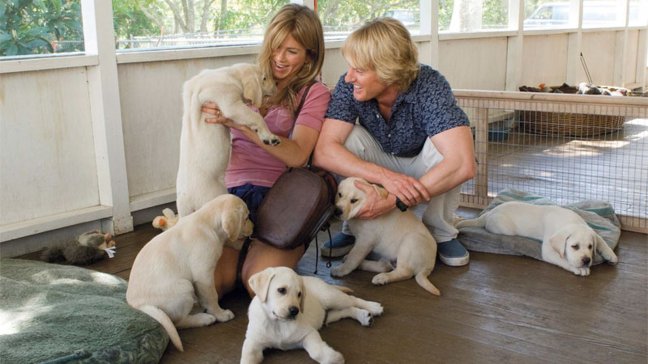
PLOT SUMMARY: Jenny is married to John (Owen Wilson), who is also an (aspiring) reporter. They move to Florida and buy a house. Jenny’s career is very successful, with her taking frequent trips abroad for work. When he senses she wants to have a baby, he’s encouraged by his friend to get her a puppy instead. They name the puppy Marley and essentially never bother to train him, so he constantly behaves erratically and wrecks their house. Instead of becoming a reporter, John writes a column, which features Marley heavily. Eventually they have kids and Jenny struggles with being a full-time Mum. They move to Philadelphia so John can be a reporter but he ends up writing a column again. The whole family loves Marley right until the end of his life.
CHARACTER TRAITS: Ambitious, intelligent, organised, patient. marley-and-me
NOTES ON PERFORMANCE: A key moment here is Jenny adjusting to being a full-time mother, having previously been more successful in her career than John. Here, Aniston expresses the frustration of having seemingly conflicting feelings, of wanting to be with her children but feeling like she’s given up a part of her identity in order to do so. She’s angry, sad, frustrated, and showing all of it convincingly. It’s a shame the film doesn’t focus more on this struggle, seeing as it’s about the only real drama in the film.
NOTES ON FILM: A real comfort blanket of a film where essentially nothing much happens and a family live a fairly privileged life. Being from the male perspective makes it all the weaker – the film is based on the book from which the columns about Marley came. Still, Jenny’s identity crisis is so much richer than John’s – at one point she even declares how exhausted she is with his dissatisfaction, despite how full their lives are – but this is not given any further exploration. Ultimately it’s a weepy about a dog that teaches children about death.
CONCLUSION: Standard Aniston is a mainly supporting role. Given that one big scene to show her dramatic skills, but otherwise usurped by Wilson’s voiceover.


BEHIND THE CURTAIN

Aside from the return of Aniston of the week, and September’s short essay on the wondrous experimental films of Dana Burman Duff, this site has been somewhat neglected of late. Programming, rather than writing has been my main occupation. Behind the Curtain is a project that was in the concept stage for a long time. The initial idea was to find a way to share with audiences, films which represent the eclecticism of my taste in cinema, so there’d be documentaries, and comedies and experimental works and more.

What came to fruition is a project that is quite close to that ideal, but with the added theme of a feminist film club. As I developed the idea, what became important was to show a cinema that is representative of all the different perspectives and creative practices of a variety of filmmakers. Behind the Curtain exists to support women filmmakers, queer cinema, filmmakers of colour and d/Deaf and disabled filmmakers – it is therefore by this very nature a feminist project.

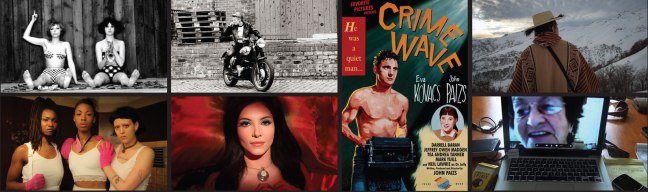
With funding from Film Hub Scotland and in partnership with Alchemy Film & Arts and Moving Image Makers Collective, I programmed and produced 7 screenings from September – December 2017 here in the Scottish Borders, where I’m based. The feminist film club theme ran most obviously through five of the screenings, with films touching upon subjects such as the construction of gender in relation to female reproduction (Maja Borg’s Man, Anna Linder’s Spermwhore), the intersection of race and gender (Cecile Emeke’s Strolling episodes 1 and 7), inequalities of gender in colonialism (Onyeka Igwe’s We Need New Names), female power, both physical and intellectual (Evi Tsiligaridou’s On Your Feet, Woman!, Vēra Chytilová’s Daisies), inherited oppression in mother-daughter relationships (Chantal Akerman’s No Home Movie), the problematics of radical feminism (Bruce LaBruce’s The Misandrists) and narcissistic feminism (Anna Biller’s The Love Witch).

Each of theses screenings inspired thoughtful conversations with the audience, especially the occasional opportunity to address a film’s relevance to feminism and the important intersections of other inequalities with that of gender.

Other film’s in the season were John Paizs’ Crime Wave, the cult, underappreciated Canadian comedy programmed by Glasgow’s Matchbox Cineclub, which depicts with a somewhat tender absurdity, the tribulations of the writing process. I also screened Further Beyond, the first feature documentary by Christine Molloy and Joe Lawlor, aka Desperate Optimists, which uses essayistic approaches, reflexive use of voice over and reconstruction to tell the story of Ambrose O’Higgins.

The intention is for Behind the Curtain to continue in some form, though I’m flexible as to what form it might take. Rather than have a fixed idea of programmes and projects I’d rather respond to the specific context here in the Borders, taking screenings to locations where there’s a shared interest in all the possibilities of an eclectic, feminist cinema.

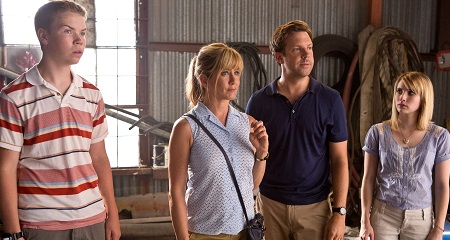
Aniston of the week: We’re the Millers

Jennifer Aniston – an actor seen frequently doing great work in poor films, sometimes excellent work in good films, and occasionally, amazing work in excellent films. How are we to know this prolific and skilled artist’s full range? We’ll just have to watch all of her films. After a hiatus, Aniston of the Week is back, and this time, it’s We’re the Millers.

FILM: We’re the Millers
DIRECTOR: Rawson Marshall Thurber
YEAR: 2013
SCREENWRITERS: Bob Fisher, Steve Faber, Sean Anders, and John Morris
CHARACTER NAME AND PROFESSION: ‘Rose’ aka Sarah, stripper.
WE-RE-THE-MILLERS-Red-Band-Trailer
PLOT SUMMARY: Rose works as a stripper and lives in the same building as weed dealer David (Jason Sudeikis). He has all his money stolen when his other neighbour, Kenny (Will Poulter) chases off some thugs from Casey (Emma Roberts) and David attempts to help. Now owing his supplier Brad Gurdlinger (Ed Helms) money, he agrees to go to Mexico to smuggle back an enormous amount of weed, and persuades Rose, Casey and Kenny to come with him, posing as a family in order to avoid suspicion. Rose only agrees to accompany David on the trip because the club she works as starts insisting the strippers also prostitute themselves, and she demands $30,000 from David. They get into Mexico easily, but have ever-elaborate ways of avoiding suspicion when they meet the Fitzgerald family – Edie and Don (Kathryn Hahn and Nick Offerman) – the latter turning out to be a DEA agent.
CHARACTER TRAITS: Caustic, intelligent, resourceful, witty, compassionate, creative.
NOTES ON PERFORMANCE: Aniston convinces as a disgruntled stripper, one who has no enthusiasm left for her job and therefore gives a low-energy performance, and her grumpy, quick-witted persona works well in scenes riffing off the smug Sudeikis. It therefore doesn’t convince at all when she suddenly offers to strip to appease the real criminals who are threatening their lives. A to-camera shrug from Sudeikis simply confirms this is just an excuse to objectify Aniston and that makes the scene ultimately really sad.
NOTES ON FILM: Well, it’s total trash. Produced and written by a band of talentless men, this shows on screen. Broad strokes, an excruciatingly lame plot, total lack of humour, stereotypes instead of characters, and infuriatingly, I actually watched the extended cut by mistake – why anyone would want two whole hours of this film on purpose is baffling to me. Real low point.
CONCLUSION: It has come to my attention that there’s a We’re the Millers 2 in the pipeline. Save us all.