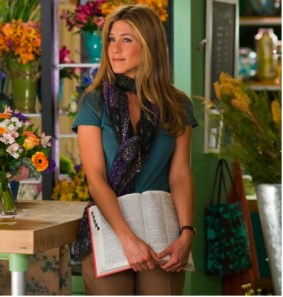
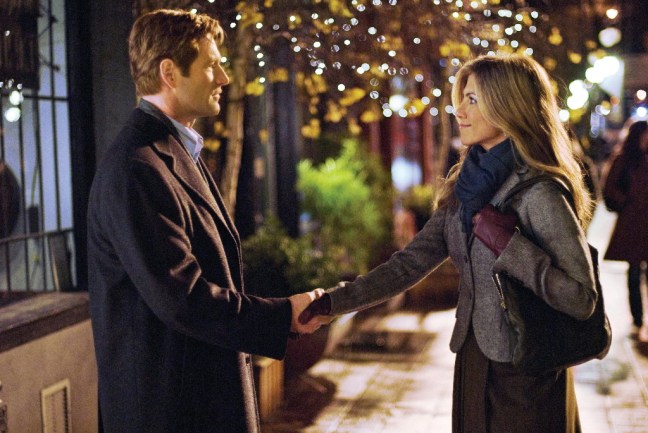
FILM: Love Happens DIRECTOR: Brandon Camp YEAR: 2009 CHARACTER NAME AND PROFESSION: Eloise, Florist PLOT SUMMARY: Eloise meets self-help guru/grief expert/boring white male Burke (Aaron Eckhart) when he flirts with her at the hotel he’s staying/leading a seminar at, while she’s delivering flowers. Burke’s wife died three years ago, and his grief coping strategies have turned into a career, helping others, but guess what? Maybe he didn’t deal with his wife’s death after all… Eloise has had a series of relationships with emotionally unavailable men, so she’s y’know, not really interested in Burke’s problems, but this is a movie so somehow she helps him anyway. CHARACTER TRAITS: Kind, ‘kooky’ (we can tell she’s kooky because she wears a scarf similar to her costume in Along Came Polly and she likes to secretly write unusual words on walls), generous, thoughtful, confident.
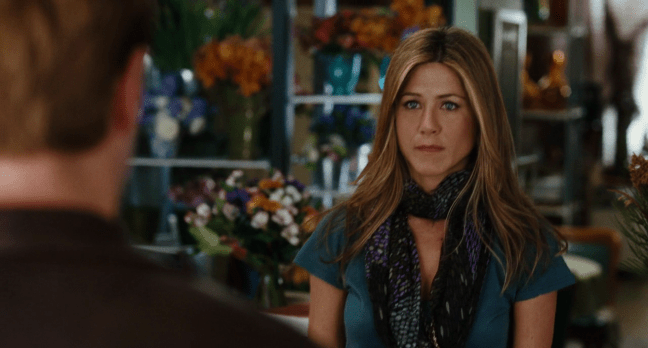
See that face on Aniston? We get it Jen, we get it.
NOTES ON PERFORMANCE: Aniston tries her best with wooden Eckhart, she’s charming and energetic and lovely, but even her efforts can’t convince us they have any chemistry. NOTES ON FILM: This is an Aniston version of a Manic Pixie Dream Girl role, where she ‘saves’ Eckhart’s repressed ‘good guy’ from the bland, safe life he’s living, and opens him up to new, authentic experiences (beat poetry, shisha pipes, bubble gum, Brandon Lee’s grave, naturally). He even Mansplains away her giving him the brush off when they first meet – it’s not that she’s genuinely not interested in him – she rejects him because she’s beautiful and she can (thanks, Burke!). The title is also totally erroneous – Burke and Eloise’s coupling is more like Lukewarm Tolerance Happens. CONCLUSION: Aniston wishes she was somewhere else, and so do we.
After a hiatus shaped like Alchemy Film and Moving Image Festival (which I produced), my viewing journal returns with a typical mix of artistic expression and popcorn nonsense. On Wednesday night the third edition of Iberodocs – Scotland’s only dedicated documentary festival and a celebration of Ibero-American cinema – opened at Filmhouse in Edinburgh to a packed audience. Begun as a way to showcase the work of Spanish, Portuguese and Latin-American filmmakers, Iberodocs has quickly developed a dedicated audience, supportive sponsors and a robust and carefully selected programme of films. A lively and welcoming reception at Traverse bar preceded the opening film, Gabo: The Creation of Gabriel Garcia Márquez, a sincere and affectionate biography of the Nobel prize-winning author of One Hundred Years of Solitude. Directed by Justin Webster, the film brings together interviews with Márquez’s friends (Gerald Martin, his biographer; Plinio Apuleyo Mendoza, writer and Bill Clinton no less), peers, family and inspired writers (Juan Gabriel Vásquez), to reflect on the extraordinary life and politics of one the world’s most celebrated literary talents.
A young Gabriel Garcia Marquez
Relying mostly on talking heads interviews, archive and television footage, Gabo chronicles the writer’s early life, student days, journalistic career, romances, his great friendship with Fidel Castro, which seemed to run counter to his anti-communist politics, and is most engaging in the use of interviews with the man himself, which demonstrate his sharp wit and idiosyncratic perspective on life. On receiving the Nobel prize for literature, a journalist asks him, “is this the greatest moment of your life?” to which Márquez replies, “No, that was the day I was born.” Such moments go some way to answer the film’s central question; how did a boy who was born into poverty grow up to be a writer ‘who won the hearts of millions?’ Márquez’s charisma, dedication, and importantly, self-belief emerge as the defining characteristics that allowed the author to have such an impact.
Iberodocs runs until Sunday 8 May and includes the remarkable and very moving, All of Me (Friday 6 May), by Arturo González Villaseñor about the Patronas, women in Mexico who prepare and distribute food to the migrants who pass by on the freight train to the US. The short film programme Looking From Afar (Sunday 8 May) also looks to be an exciting collection of highly personal works from such sharp artistic talents as Salomé Lamas and Ana Vaz.
Anton Yelchin and Alia Shawcat in Green Room
Elsewhere in my viewing, Jeremy Saulnier’s third feature as writer/director, Green Room surpassed my expectations, which were based on some buzz around Patrick Stewart portraying a skin head Nazi in backwoods America. Stewart certainly is suitably chilling in the role of Darcy, but what’s most interesting about Saulnier’s work, as with Blue Ruin, is how, unlike many a director of dark and violent films, he appears not to celebrate violence, but rather, violence occurs due to ingrained social expectations and justifications of power, and is horrific and visceral in a very authentic, non-stylised way. Green Room cinematographer Sean Porter creates a dank, dark atmosphere using very little light, whilst editor Julia Bloch uses neat and clever cuts to keep the pace fraught and the horror efficient.
l-r: Anthony Mackie as Falcon, Jeremy Renner as Hawkeye, Chris Evans as Captain America, Elizabeth Olsen as Scarlet Witch and Sebastian Stan as Winter Soldier in Captain America: Civil War
Finally, this week I saw Captain America: Civil War, which gleefully allows members of the Avengers A and B team (and some other ‘enhanced’) to shine, within excellently choreographed and edited action set-pieces. The film somehow doesn’t convey the ethical complexity of the Civil War comic books, despite the presence of a menacing Daniel Bruhl. It’s also still deeply frustrating to see only three female characters with speaking roles in these films (where’s Cobie Smulder’s Agent Hill?!) and only two women a line-up of super dudes. I’d love to see a Black Widow (Scarlett Johansson) origin story, but the possibility of that seems nil.
Also watched:
What Happened Miss Simone? Liz Garbus, excellent documentary
Season 7 of Parks and Recreation (again)
This week, we take a look at Aniston’s post-Pitt break up movie, in which she stars with that loveable, fast-talking rogue, Vince Vaughn, as his exasperated partner.
FILM: The Break-Up
DIRECTOR: Peyton Reed
YEAR: 2006
CHARACTER NAME & PROFESSION: Brooke Meyers, Art Dealer
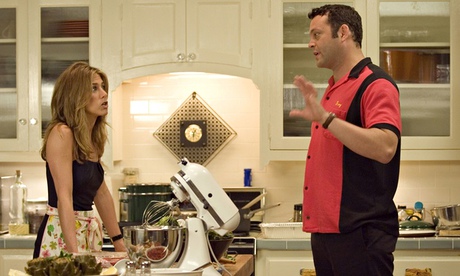
PLOT SUMMARY: Brooke and Gary (Vince Vaughn) are in a long-term relationship. They live together in a comfortable apartment in Chicago. One day, Brooke becomes tired of Gary’s selfishness and immaturity, when he fails to support and help her in the preparation of a family dinner. Having been through the same argument several times, she decides to break up with him, hoping he will change his ways to win her back. Instead, on getting some pretty poor advice from his best friend Johnny (Jon Favreau), who immediately suggests Brooke is sleeping with someone else, Gary starts playing games in order to drive he rout of the apartment. Brooke retaliates with her own childish behaviour. Eventually they get to the heart of why they fell out, but by that time, they’ve hurt each other too much to reconcile.
A man who likes to play games, of course!
CHARACTER TRAITS: Generous, sharp, resourceful, patient, impetuous.
NOTES ON PERFORMANCE: Aniston is excellent here. Brooke begins by appearing as a typical over-achieving woman, presented in broad strokes – taking the burden of creating a lovely home and maintaining a great career – but then a highly nuanced performance emerges. When Brooke eventually reveals her heartache, Aniston conveys her pain acutely, showing her struggle to communicate her true feelings in the face of such an overbearing partner.
Enter a caption
NOTES ON FILM: What’s brilliant about The Break Up is that the drama is weighted equally between the two leads, so that Brooke’s internal life and Gary’s poor decisions are portrayed with equal sensitivity and humour. This is also clearly to aid the audience to ‘pick a side’ as the marketing so blatantly suggested, and to an extent Brooke and Gary can be seen a characters simply conforming to male and female conditioning. He’s boorish and self-absorbed, obsessed with getting a pool table, she’s complimented for her home decorating skills by her mother etc. There’s also a pretty silly last act reveal from Favreau’s Johnny, who suddenly comes out with the insight about Gary that would have been pretty helpful to him at the start, but hey, that would ruin the fun, right?
Also worth noting this is the third film we’ve seen Jason Bateman and Aniston appear in together (he plays the couple’s realtor).
CONCLUSION: A seriously good Aniston film, mostly well written and beautifully performed.






 cinematicinvestigations.com