
Review: Mania Akbari’s One. Two. One

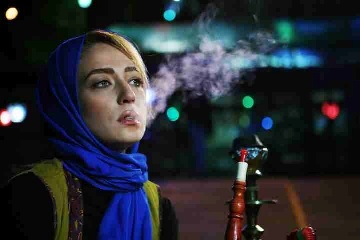
phpThumb_generated_thumbnailjpgAt Edinburgh Film Festival in 2012 I had the pleasure of meeting director Mania Akbari ahead of the European premiere of her film, One. Two. One (Yek. Do. Yek). Mania was polite, charming and possessed of a fiercely intelligent wit – as her beautifully accomplished films demonstrate. During her introduction to One. Two. One, Mania described her fascination with micro expressions – that the smallest facial movement or hair falling across the face could reveal so much about the inner feeling of the character. That One. Two. One is composed of mainly close-ups and two shots attests to this fascination, showing the full extent of each impressive performance, most notably Neda Amiri as central character, Ava. 121sos-300x167
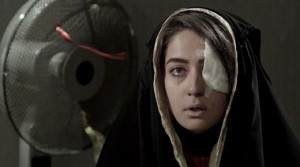
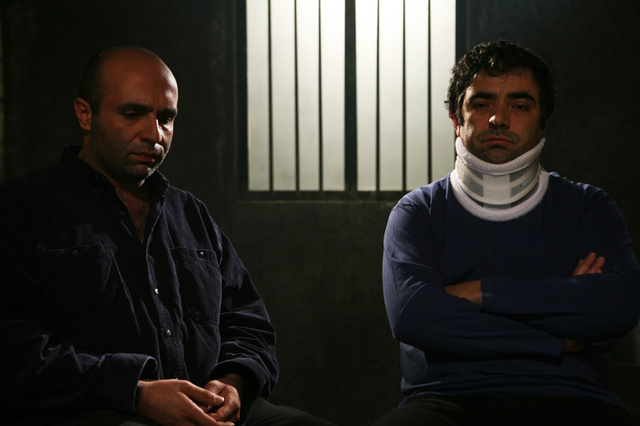
Beginning in a skin therapy clinic where Ava is being treated for facial scars inflicted as the result of an acid attack, the film then consists of a series of conversations between people connected with her and the incident, including her friends, family, lovers, and the man responsible for the attack. Shots are still, with camera movement limited to panning back and forth between characters, oscillating between two points of view that gives gesture central prominence. Ava’s physical disfigurement is not the only damage that has been inflicted on her, as she feels deeply the pressure to hide her imperfection from a society that places a high value on a woman’s beauty. In the clinic her treatment is accompanied by advice and comments from friends, whilst visits to the Psychiatrist and fortune-teller focus on the anxiety of Ava’s dreams. ONE-TWO-ONE_3
In Akbari’s From Tehran to London, another character (also called Ava and played by Neda Amiri) is seen with her husband getting ready in the bathroom, the repetitive gestures of grooming emphasised using close-up in the mirrors’ reflection. Both Ava and her husband, in this scene, tease and taunt each other in a playful prelude to the dramatic fall-out that awaits them. Here, Akbari focuses on female beauty in a film that uses the construct of marriage to examine gender inequalities in Iran. With One. Two. One gender is again explored, but the tone – established by the tightly composed framing and still shots – is more sombre, exploring deeply the psychological implication of attempting to conform to acceptable standards of beauty whilst hiding half of one’s face.

Now exiled from Iran following the making of From Tehran to London (the director fled in fear when members of her crew were arrested), Mania Akbari is the subject of a BFI retrospective that seeks to celebrate the outstanding accomplishments of this most courageous filmmaker. One. Two. One is unexpected pleasure, a moving, considered and important work, that benefits from repeat viewings.

“Pretend you’re in a movie” Spring Breakers in review.

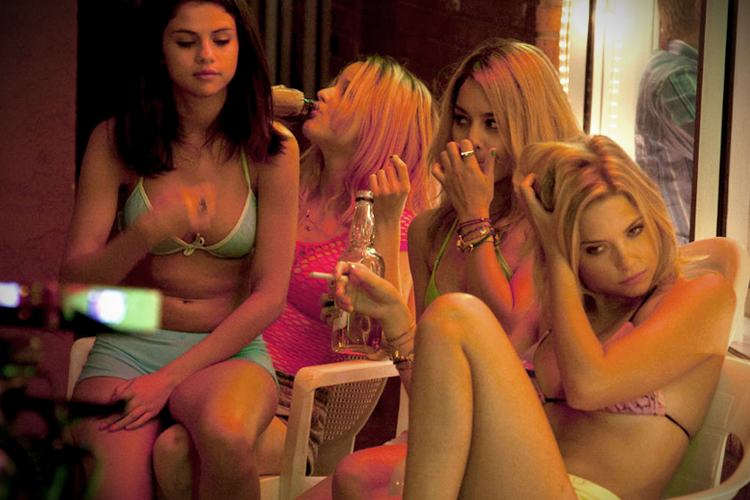
WARNING: SPOILERS. Harmony Korine’s latest cinematic offering following such simultaneously celebrated/reviled recent flicks, Mister Lonely (2007) and Trash Humpers (2009) has provoked some predictable tirade’s from journalists seemingly interpreting Spring Breakers based purely on the amount of flesh it displays. What’s interesting about that point of view is that it judges the characters where the film itself does not. spring_breakers1

Centering on the hedonistic activities of four female college student’s, who – having pooled their resources and come short – rob a chicken restaurant and head to Florida to join the ‘Spring Break’ party – Korine’s film is a lurid, day-glo, noisy affair, making much of the post-Disney rebellious personas of his stars, Selena Gomez and Vanessa Hudgens. The opening scenes present either a hell or heaven on earth – depending on your perspective – all naked bodies and beer-swilling guys accompanied by the dub-step/trance onslaught of Skrillex. Indeed Gomez’ character is a Christian (her name is Faith) seen at church group before joining her colleges pals, but the opportunity presented by readily available drugs and sexual liberty isn’t what tests her moral integrity. spring-breakers-handcuffed

After being arrested, Faith, Candy (Hudgens), Brit (Ashley Benson) and Cotty (Rachel Korine) are bailed out by Alien (James Franco), a self-styled rapper/dealer boastful of all his ‘shit’ – money, weapons, every colour of shorts (Franco and Korine reportedly based Alien on Riff Raff). Where her friends are elated by the freedom this new allegiance brings, Faith is uncomfortable with the expectations she perceives Alien to have in return, and in one of the films more intense scenes, refuses his persuasion tactics, despite how fervently he insists that he just wants to have ‘fun’.

What’s so consistently engaging about Spring Breakers is how Korine maintains a certain distance, and thereby non-judgemental approach to his characters. Candy, Brit, Cotty and Faith seem familiar, in that they behave in a way that we might have come to expect from particular cinematic/pop-cultural ‘types’; and their posing for Alien suggests learnt behaviour based on what they might expect from a ‘gangster’s’ moll, or groupie, even, and this double assumption means that the viewer is ever questioning how seriously to take all this brightly coloured mayhem. spring-breakers-ski-masks

What eventually transpires proves that wry incredulity is perhaps the right approach all along, as the characters actions become more implausible; the final scene a beautifully constructed fantasy of almost arbitrary violence. Before their chicken-shack hold-up, Candy encouraged her cohorts to ‘pretend they’re in a movie’ (one of the film’s less effective moments) in order to get in the frame of mind for ‘armed’ robbery, but a later flashback depicts the episode as raw and disturbing – their manic, graphic, verbal fireworks having the desired – terrifying – affect on their victims. By the end, Candy and Brit enact the kind of overblown computer-game styled killing spree that they perhaps imagined all along.

DVD Review: The Confrontation by Miklós Jancsó


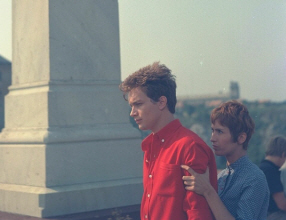
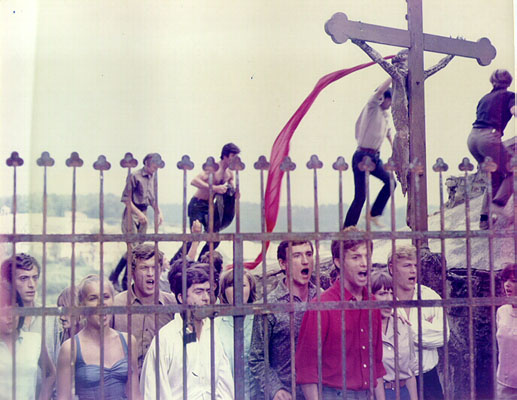
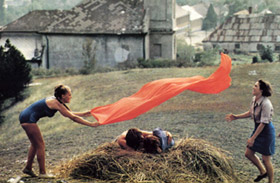
 Confrontation Watching Miklós Jancsó’s The Confrontation (Fényes szelek, 1968) one can’t help but think of famous US melodramas about troubled youth and the struggle against hypocrisy such as Rebel Without a Cause or West Side Story. In his first foray into colour film, Jancsó proves himself as much a master of a striking palette – costuming his actors in symbolic red, for example – as he had demonstrated himself capable of building tension through a careful choreography of individuals such as in The Round Up or The Red and the White. Rather than the personal traumas of such US classics, with their focus on racial, familial or romantic power struggles, The Confrontation uses music and dance to muse upon and dissect the political ideology of students, in the wake of newly founded Communist rule in 1947 Hungary. Clearly reflecting the events of the time – student riots in Paris – Jancsó’s vitality as a director is perfectly attuned to balancing weighty, philosophical dialogue and the inner squabbles of the student group, with striking visual flair.

At the start we see a group of students stop military cars on the road in a pacifist demonstration, blocking their way and lying on the ground when provoked to move on. Gradually some of the soldiers join them in dancing, but their actions are watched at all times by the police officer, Kozma (András Kozak, of The Red and the White) who’s offering of advice or criticism seems to provide the audience perspective as the actions of the group escalate. Entering a monastery in order to challenge the pupils there regarding their ideas of democracy, free education and the use of power; the leader, Laci (Lajos Balázsovics) becoThe-Confrontation-33820_5mes challenged himself when another of the group, Jutka (Andrea Drahota) deems his non-violent negotiation and debate-based tactics too weak to accomplish their goals of imposing Marxist teachings.

Using somewhat underhanded tactics to topple him from leadership – she claims a majority decision has been made but no evidence is shown to back up her pronouncement – Jutka then proposes more aggressive modes of persuasion. The notion of the group as terrorists hangs over the action of the film – and is demonstrable by their humiliation of non-conforming pupils via tactics that veer dangerously close to those of Nazi concentration camp officers. That hair-shaving doesn’t take place, but vandalism does; ultimately becomes controversial enough for Jutka’s power play to be disciplined thus proving that within political parties, the consensus regarding objectives – such as imposing Marxist ideology – is subject to the same internal (and essential) diversionary ethical debates regarding methodology.

Typical of Jancsó, the action is shot using long, fluid takes; camera movement following individual conversations, then slowly zooming out to focus on the group singing, then pausing on specific confrontations. It’s gorgeously rendered and choreographed, the brightly dressed students contrasted with those of the monastery in their grey uniforms enhancing the way the film uses musical genre conventions and their expectation of melodramatic subject matter to incongruous effect. Accompanying this fantastic restoration by Second Run DVD is a detailed and fascinating essay about Jancsó’s career by author Graham Petrie, which provides insight to the great director’s political and aesthetic filmmaking trajectory.