Thoughts on LFF 2015: Couple in a Hole and The Survivalist

Two British films at LFF stood out for depicting alternately intentional and enforced isolation. Tom Geens’ Couple in a Hole saw Scottish actors Kate Dickie and Paul Higgins as Karen and John, a couple who have decided to live just as the title suggests, in a forest in France. By contrast, but with thematic overlaps, The Survivalist directed by Stephen Fingleton and set in Northern Ireland, focuses on the attempt of one man to maintain solitude in a post-apocalyptic world. In both instances, the maintenance of isolation seems futile, as outsiders find a way to help and/or disrupt the routines of those living off the grid.

Couple in a Hole obscures the reasons behind Karen and John’s choice to dwell underground, until their routines are well established. They’ve developed roles for themselves as nurturer and hunter, where John has the responsibility of tracking, killing or gathering food for them. A collection of bugs or mushrooms is a delicious treat served on a leaf-plate. Karen however, suffers from agoraphobia, only attempting small progressions to the outside under John’s careful encouragement. This set-up is depicted by Geens as one the couple both take comfort in, and the director portrays their lush forest environment and the surrounding hills as something of a rural idyll. Sam Care’s cinematography captures the beauty of both the wide expanse of countryside and the safety of the forest enclosure.
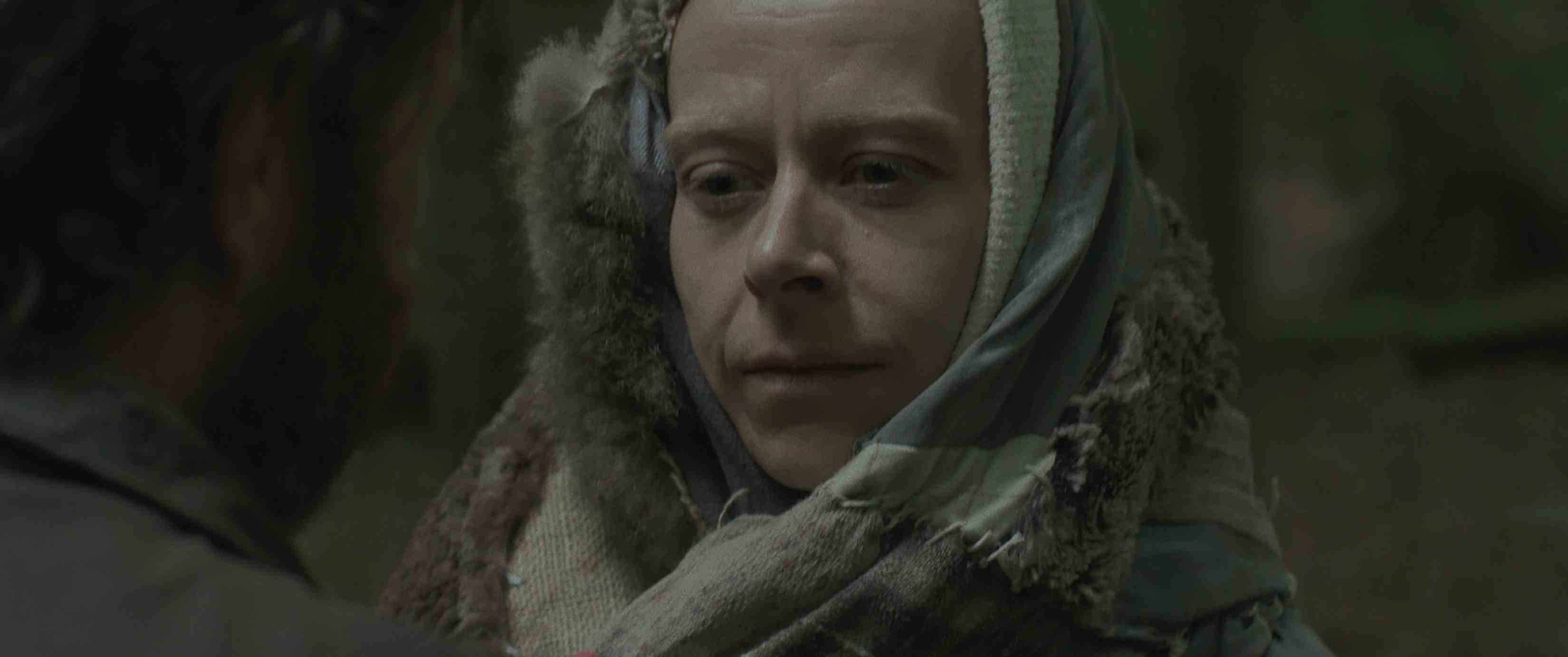
Kate Dickie as Karen

There’s an inevitability to the way their small world becomes disturbed, due to the oddness of their circumstances. Karen and John’s living situation is so far removed from the constantly connected consumer driven one we’ve become accustomed to that it feels like our time is simply biding until ‘something’ disturbs the peace. That something is a poisonous spider bite that drives Karen screaming back into the hole after an all too fleeting moment outside her enclave. This event allows Geens’ great reveal, the sight of John venturing to a village near the forest that at once brings into focus what the couple had relinquished in order to achieve something like peace.
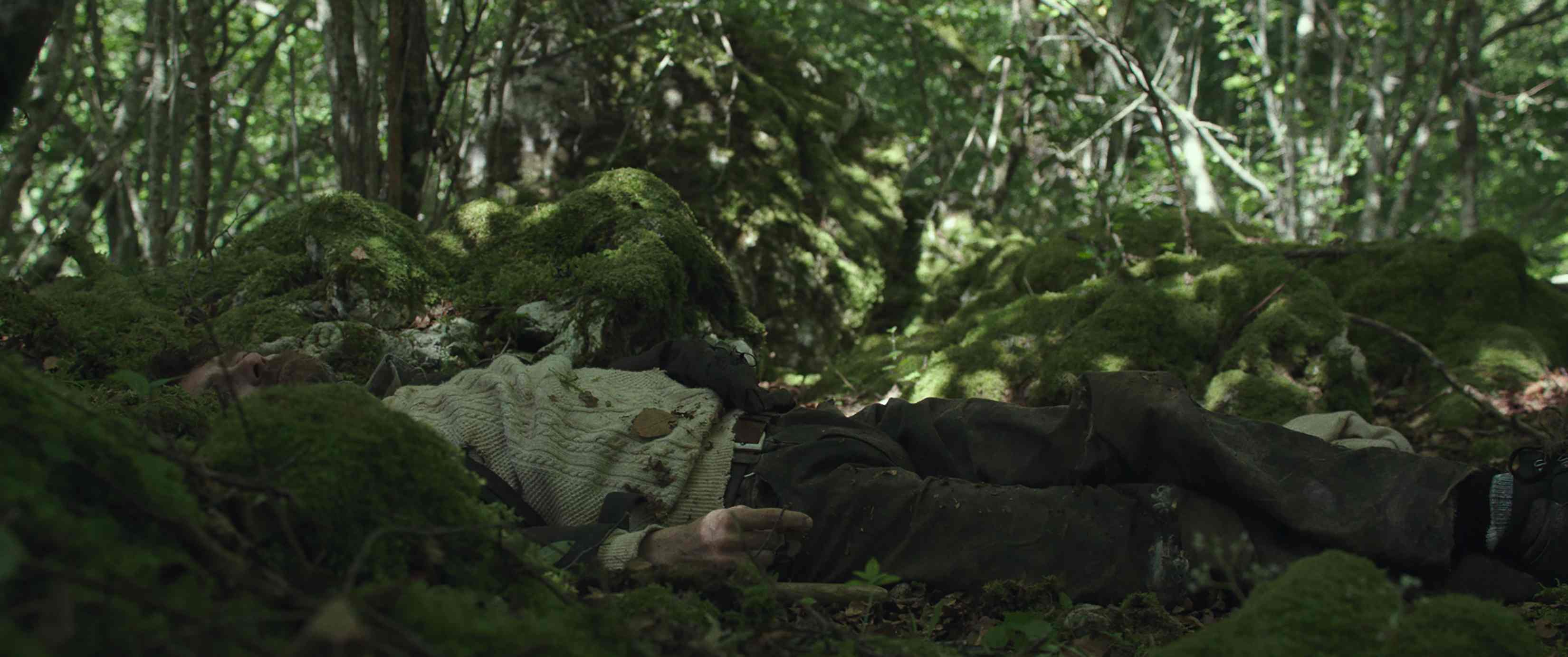
Paul Higgins as John

The events that follow John’s village excursion escalate the plot towards a conclusion more baffling than the original set up. Though there’s something a little disappointing about the eventual resolution of Couple in a Hole, its style and creativity make the film hugely enjoyable, not least of all due to the synth heavy, atmospheric score by BEAK.

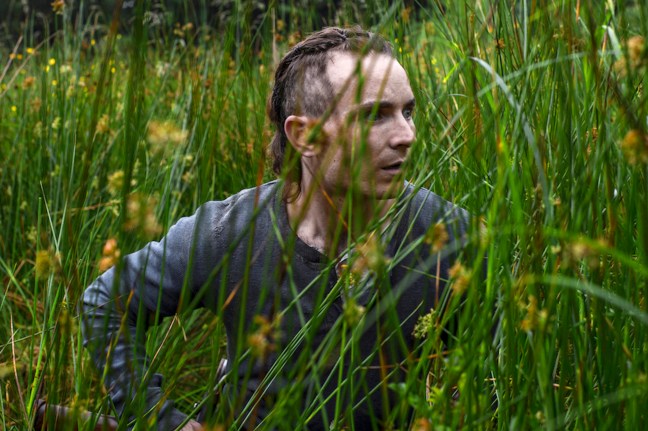
The Survivalist too, has a forest setting, this time a farm built and maintained by a lone man (Martin McCann) who has gathered impressive resources to keep himself alive. Director Stephen Fingleton signifies the end of civilisation at the outset using the simple graphic of a population line on a chart drastically descending. No other information to explain the film’s set-up is given and throughout, dialogue is kept to an absolute minimum, as though conversation has become a luxury that the characters cannot afford. For the film’s first fifteen minutes, not a single line is uttered, as the routines of farming and hunting are shown alongside the suggestion that the Survivalist’s loneliness might be affecting his perception. When a woman, Kathryn (Olwen Fouéré) and her daughter Milja (Mia Goth) arrive one day seeking shelter, this suggestion of deep sadness only enhances the extreme caution with which the survivalist treats his visitors.
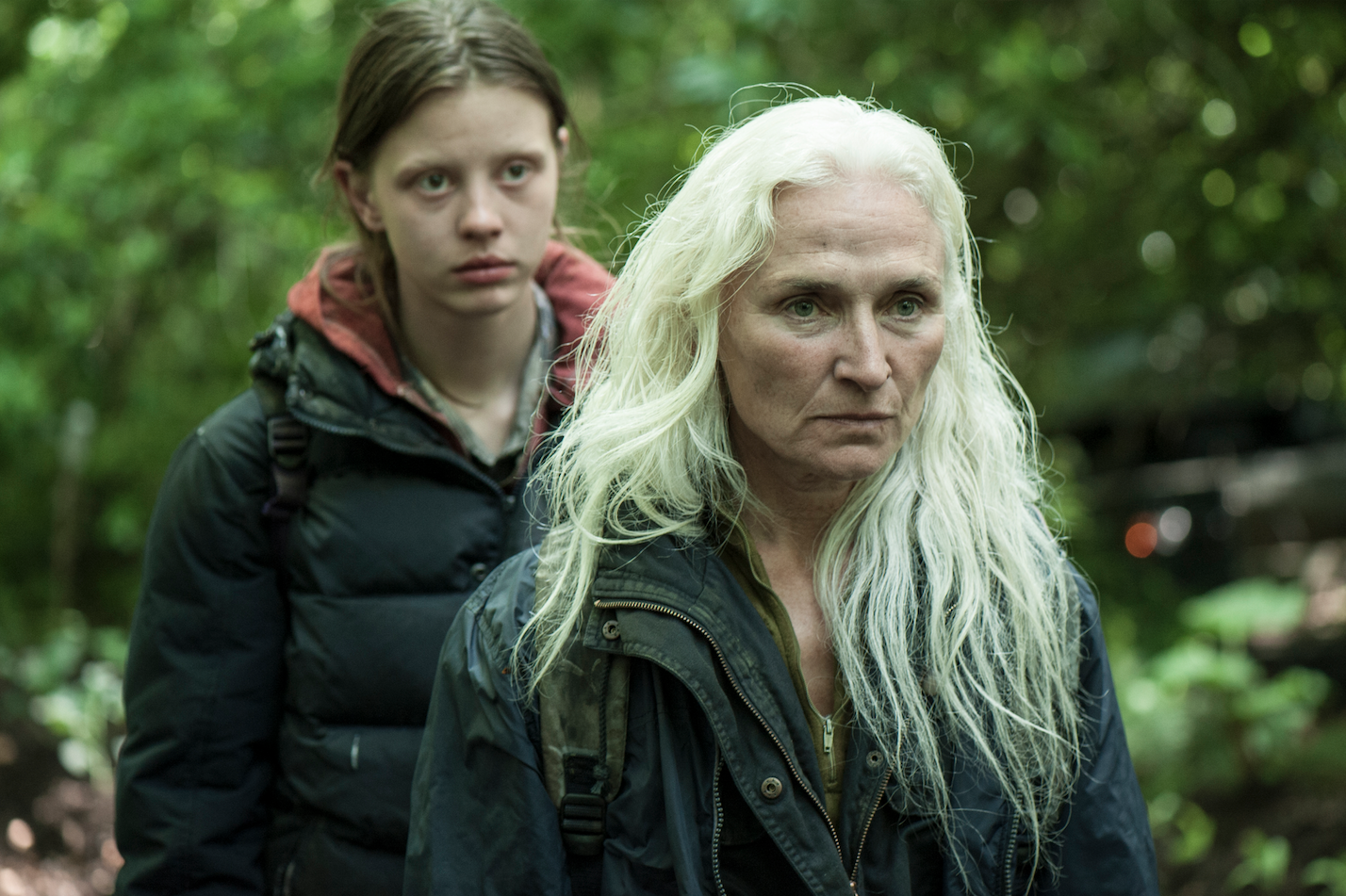
Mia Goth as Milja and Olwen Fouéré as Kathryn

Quickly an exchange of sex for food is established, and Goth dismantles first impressions of her open-faced innocence by portraying Milja as someone in command of her body as commodity. What The Survivalist does well, despite the familiarity of the post-apocalyptic setting, is consistently shift the viewers allegiance to the characters. McCann’s performances allows his character to be sympathetic due to his gradual trust of his new house mates – his vulnerability is relatable – but his instincts never leave him. Milja meanwhile, emerges as the heart of the film, going to extreme lengths to protect herself in a way that makes her the character to truly invest in.

The Survivalist uses gesture, glance and sound in a convincingly efficient way to show the bareness of life for its characters. At the same time, the slippage into dreams and memories that the survivalist succumbs to at night, provides an opportunity to suggest the true darkness outside of his immediate environment, through a distortion of natural sound.

Stripping back the survival story to its essential elements – without a zombie threat as in The Walking Dead, or a family narrative as with The Road – makes The Survivalist ultimately deeply involving. Fingleton creates an atmosphere of constant threat within a tangible natural environment, and when the new stability is again demolished, the prospect of a more hopeful future provides an authentic and satisfying conclusion.
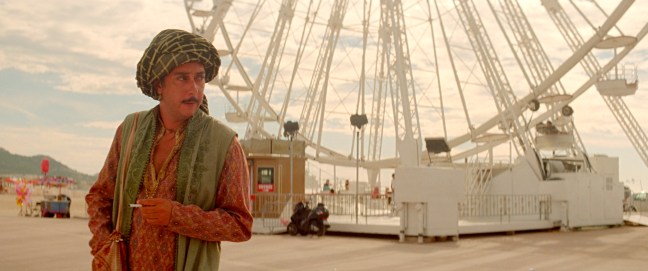
Thoughts on LFF 2015: Arabian Nights

The BFI London Film Festival ran from 7-18 October, opening with Sarah Gavron’s Suffragette and closing with Danny Boyle’s Steve Jobs. Whilst there, I caught neither of these (natch), but did see a host of other new films, most of which had been around the festival circuit for a while but were making their UK debut in the English capital. A highlight was Miguel Gomes’ Arabian Nights which had its world premiere in Cannes this year and is structured in three parts; Volume 1: The Restless One (125min), Volume 2: The Desolate One (131min), and Volume 3: The Enchanted One (125min). Seeing all three films back to back (with 30min breaks in between) at LFF, might happily make the experience one to include in those deemed ‘endurance cinema.’

Gomes previous films, Our Beloved Month of August (2008) Tabu (2012) and Redemption (2013) all play gleefully with notions of documentary and testimony. Actors are commonly non-professional, playing versions of themselves in re-enactments of events in their own lives, mixing with professional actors too. Arabian Nights takes this even further, using the structure of Scheherazade’s tales to present fictional stories about the economic, social crisis in Portugal from July 2013 – August 2014. At the same time, the director is all too aware of the problematic nature of his approach, presenting himself at the outset as a man in crisis, wondering how he can resolve his social and political responsibility with his desire to present ‘wonderful stories.’ He runs away from his crew, and upon finding him, Gomes’ destiny is to be punished according to ‘the Law of Cinema and Audio Visual Media’.

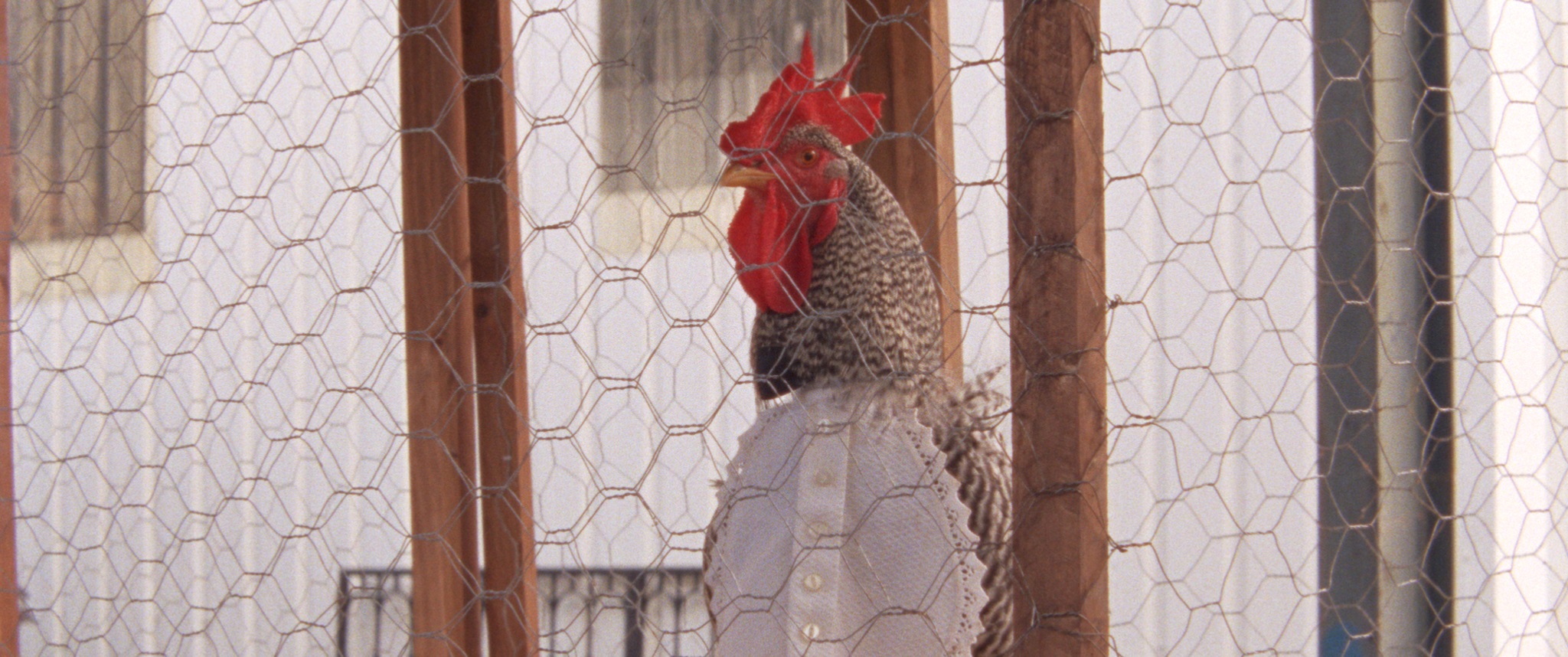
Still from Volume 1: The Restless One, The Story of the Cockerel and the Fire

This irreverent and contradictory approach is what makes Gomes’ films so involving, at once he appears deeply concerned about ethics and committed to confounding his audience. So in Volume 1: The Restless One, we see the story of The Men with Hard-ons, where Portugal’s political elite are usurped by their own desire for virility, whilst in The Story of the Cockerel and the Fire, a cock that crows before dawn is tried by a committee for disturbing the peace, and defends itself through a translator. It’s elements like this that bring to mind an absurdist tradition along the lines of The Marx Brothers, Monty Python or more recently Athina Rachel Tsangari (Attenberg, Chevalier).

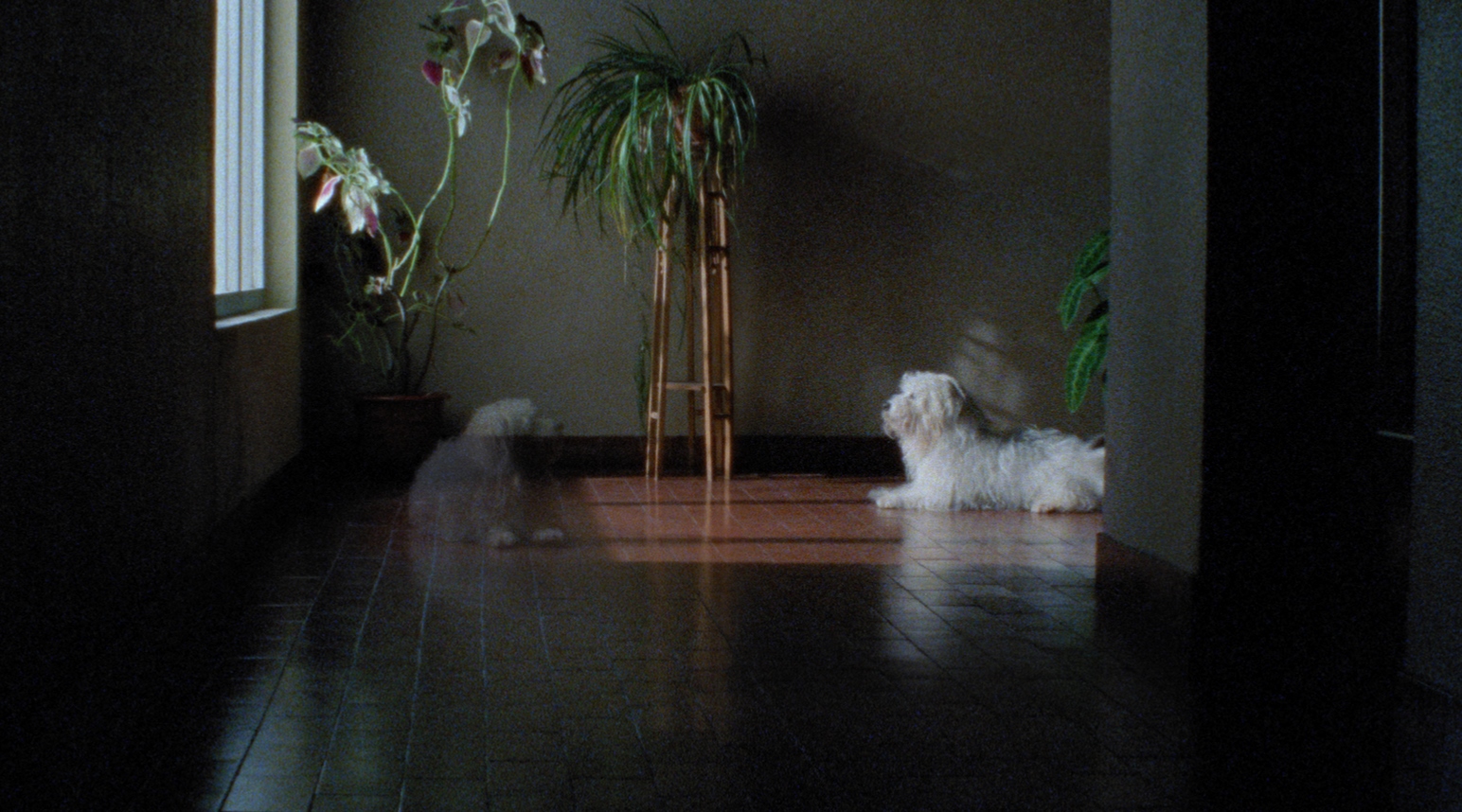
In Volume Two: The Desolate One, the true story of a couple who took their own lives in a tower block, becomes the basis for a narrative about a dog who encounters their own ghost, in The Owners of Dixie. Here Tabu actor Teresa Madruga plays Luisa, one of Dixie’s owners, giving a moving performance of a woman becoming gradually overwhelmed by her circumstances.

Still from Volume 2: The Desolate One, The Owners of Dixie

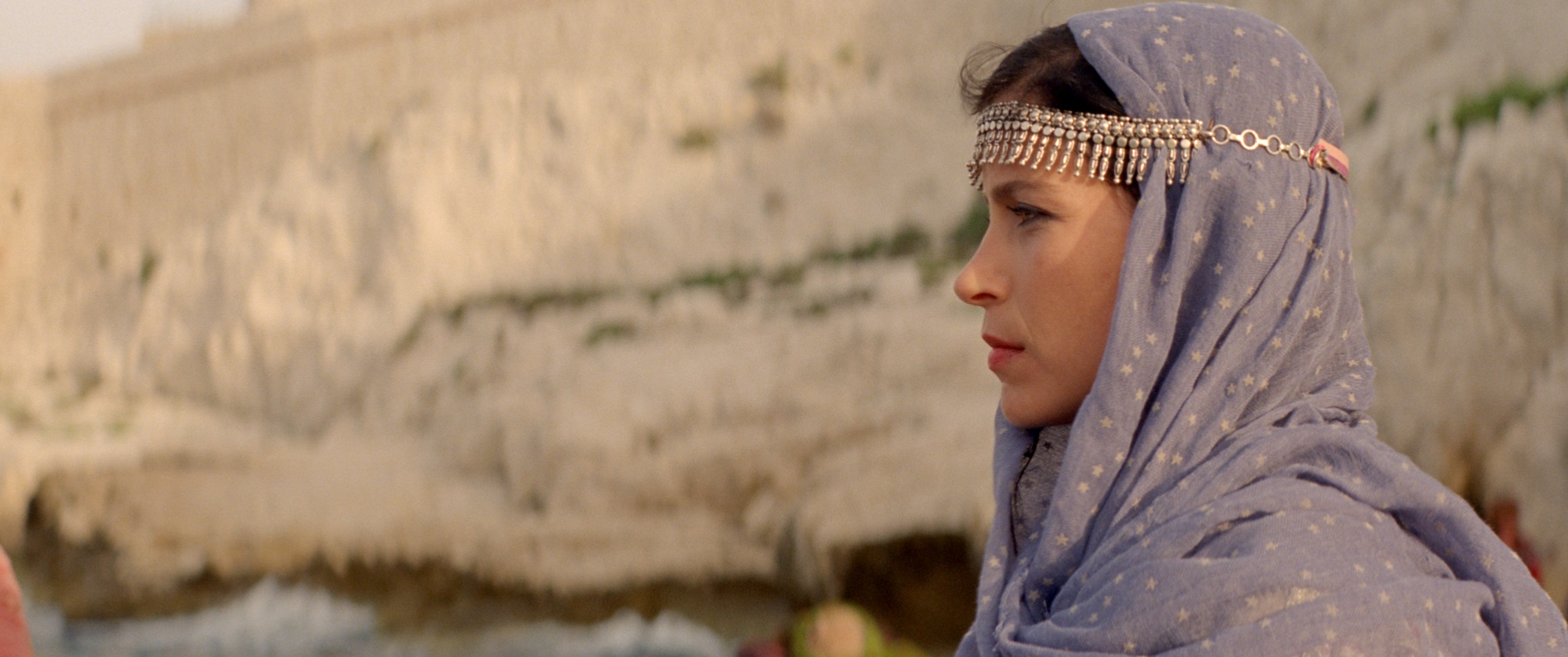
Gomes worked with cinematographer Sayombhu Mukdeeprom, known for creating the lush look of Syndromes and a Century and Uncle Boonmee Who Can Recall His Past lives (among others) for Apichatpong Weerasethakul. Throughout Arabian Nights, the use of 16mm and 35mm creates a depth of colour and texture that enhances the film’s atmosphere, seeming to make the experience of the characters somehow more palpable. In Volume 3: The Enchanted One, the sun-drenched Mediterranean, standing in for Bagdad, looks utterly gorgeous, as we see Scheherazade (Crista Alfaiate) encounter the inhabitants of the archipelago, such as Carloto Cotta’s hapless and endearing Paddleman. Later, Volume 3 becomes almost entirely a document of Chaffinch training and singing competition, though structured loosely, it’s impossible not to become invested in the fate of these little birds and their dedicated owners.

Still from Volume 3: The Enchanted One, Scheherazade (on the 515th day of narrating stories to the King)

That Arabian Nights became three films is down to the looseness of Gomes’ production plan at the outset, and the resulting volume of footage shot – somewhere there is a nine hour version of the film. In an interview with cinema scope, Gomes talks of the film as being equally one film and three, so that either volume would come to represent the whole experience that he wanted to give the audience. By explicitly using a storytelling structure – a story leads to another (actually something like Guy Maddin’s The Forbidden Room, which also screened at LFF) Gomes perhaps makes more explicit than in previous films, the critique of narrative that has consistently concerned him. Does a ‘documentary’ perhaps deceive its audience by presenting something ostensibly ‘real’? A document of social distress, told through the narrative of, say chaffinch trainers channelling energy previously dedicated to regular employment, is perhaps most compassionate and honest when communicated as a collaboration of document/performance between director and ‘actor.’

NB – for anyone located in or around Edinburgh, you can see Miguel Gomes’ Our Beloved Month of August as part of the Edinburgh Film Guild programme, LOCAL/LOCALE. More info here. Facebook event here.

Announcing a mini film season: LOCAL/LOCALE

Starting next month on Sunday 8 November, the Edinburgh Film Guild will be host to a mini season of film’s I’ve programmed around themes of location, community and industry. The season will showcase examples of cinema that dissolves the divide between documentary and fiction and offer in turn, intelligent, beautiful and humorous comments on the human condition.

Each film is one that’s provoked thoughts in me about the diversity of human experiences that I might only ever encounter through cinema. In the ways that each film uses narrative and documentary to reveal their subjects, they allow us to question the authenticity of the experience that we’re witnessing. How much is ‘real’ and how much is an embellishment?

In the coming weeks I’ll post more details about the films in the programme, but this is just a small teaser of what’s to come. More info here at the Edinburgh Film Guild’s site.

Sunday 8 November: MAN OF THE STORY (KATHAPURUSHAN). Adoor Gopalakrishnan/India, Japan/1995/102/Malayalam with English subtitles.

Sunday 15 November: WHITE COAL. Georg Tiller/Austria, Poland, Taiwan/2015/70 min/English and Chinese with English subtitles.

Sunday 22 November: ALLUVION/EVERGREEN. Alluvion/Sasha Litvintseva/UK/2013/31min. Evergreen/Sasha Litvintseva/UK/2014/50 min.

Sunday 29 November: OUR BELOVED MONTH OF AUGUST (AQUELE QUERIDO MES DE AGOSTO) Miguel Gomes/Portugal, France/2008/147 min/Portuguese with English subtitles.

Sunday 6 December: TIRED MOONLIGHT. Britni West/USA/2015/76 min.

Also: Film journal update. Viewed two brilliant detective/serial killer films: David Fincher’s The Girl with the Dragon Tatoo and Michael Mann’s Manhunter