My week in film, 20 Feet from Stardom, Calvary, The Double and more…

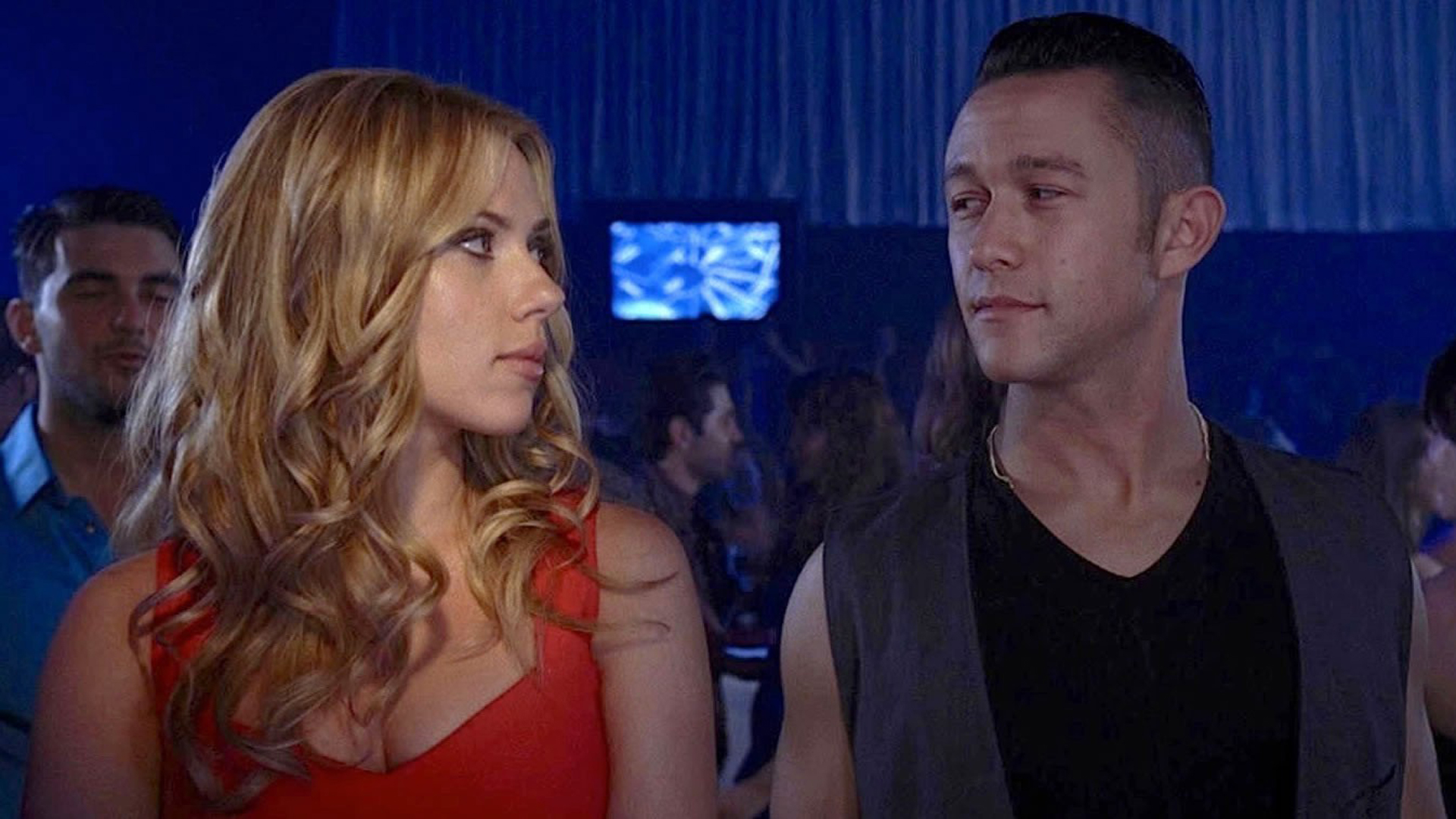
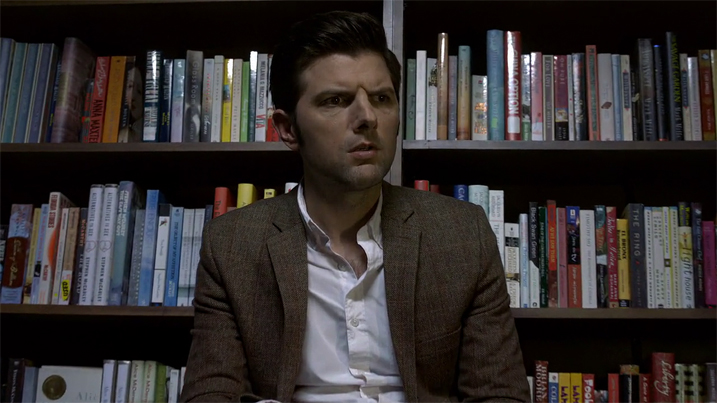
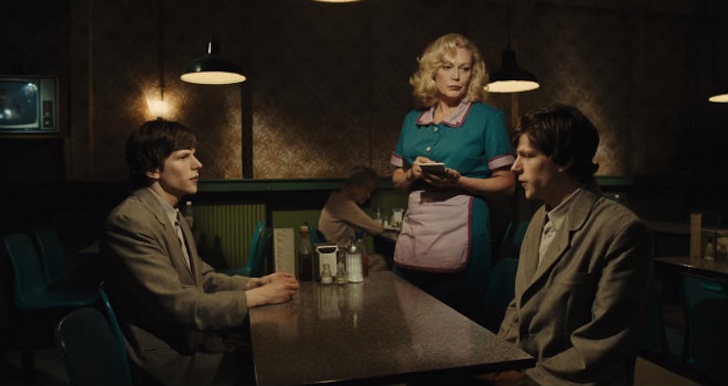
This post will hopefully mark the resurrection and continuation of My week in Film… (though this new instalment technically covers a selection over two weeks) after a lengthy hiatus due to my day job as a Festival/Programme Coordinator. Inevitably when working for a film festival the only films I’m able to see are those in the programme, however due to the month-long nature of AV Festival (my current gig), and an average schedule of one film per day, I did manage to see Under the Skin (Jonathan Glazer) and The Grand Budapest Hotel (Wes Anderson). With Glazer’s unnerving film I was equally impressed and irked by the melding of documentary style shooting and stylistic, art-horror sequences, not to mention a fantastic performance by Scarlett Johansson, whilst Anderson’s latest film was simply joyous, perhaps closest to Fantastic Mr Fox in tone and noticeably more vicious (Goldblum’s fingers!) than previous offerings.  Clavary Attempting to catch-up with current releases, I saw the much-hyped Calvary in which, following The Guard in 2011, Brendan Gleeson again brings his considerable charisma to the central role for writer/director John Michael McDonagh. That the film is an allegory is clear, and the attempt to approach the subject of the Catholic church’s culpability and guilt with the director’s characteristic dark wit is engaging and entertaining, but I couldn’t forgive what amounted to a cast of caricatures in place of real characters, and a self-awareness in the dialogue that was outright smug. For a well-balanced review, see Donald Clarke in the Irish Times. 20-feet-from-stardom-review-photo20 Feet From Stardom (Morgan Neville, 2013) was everything I expected from this Oscar winning documentary – an all-star cast of contributors including Mick Jagger, Stevie Wonder, Bette Midler and Bruce Springsteen, singing the praises of the backing singers who brought depth and soul to their recordings from the 1960s to the present. Slickly edited with a strong focus on showcasing the very talent that normally goes unnoticed, what is so enthralling about the lives of these singers – including Darlene Love, Merry Clayton, Lisa Fischer and The Waters – is hearing of their less-successful solo careers and the suggestion that despite their raw talent, what prevented them from becoming ‘stars’ was sometimes their lacking in the ability to self-promote, to perhaps take on the role of the exhibitionist that seemed to come so naturally to performers like Tina Turner or The Rolling Stones. For Táta Vega, there could only be one Aretha, no matter how often her substantial talent was compared to the legendary soul singer. The film undoubtedly provides the recognition these singers deserve, revealing one astonishing performance after another, that will surely change the way we listen to songs like Gimme Shelter or Young Americans forever. the-double-trailerFinally I saw Richard Ayoade’s The Double, an adaptation of Fyodor Dostoevsky’s novella of the same name, which sees Jessie Eisenberg play a man named Simon James – a person infuriatingly incapable of even the simplest of human interactions – whose life is irrevocably harassed by the presence of his doppelganger, James Simon. Ayoade and co-writer Avi Korine create a distinctly desperate world for their protagonist, whilst Andrew Hewitt’s score provides a perfect prickliness to compliment Simon’s drab environment. Perhaps the most joyous part of Ayoade’s second feature is the fictional action sci-fi TV show seen on monitors littered throughout the otherwise grim world the characters inhabit. Appearing at crucial moments as if to antagonize Simon’s ineffectuality, Paddy Considine stars in a gleefully retro styled show called The Replicator, in a nod to Ayoade’s involvement as writer/actor in Garth Marenghi’s Darkplace (2004) which also provides perhaps the perfect continuation of Considine’s performance as a ‘psychic’ alpha male, would-be home wrecker in Submarine.

FrancesHaBowieRunning

Also viewed: Celluloid Man (Shivendra Singh Dungarpoor, 2012), full review here, the glorious Frances Ha (Noah Baumbach, 2013) – just as good on second viewing, Say Anything (Cameron Crowe, 1989) – in which, though it makes obvious why John Cusack became such a big star, is actually a rather baffling film, switching from tender youthful romance to high-stakes crime dad, fear of flying awfulness. Finally the past fortnight also saw me revisit Jean Renoir’s La Règle de Jeu (The Rules of the Game, 1939), which is still just a remarkable film.

To preserve the reel, Celluloid Man reviewed

“I understood the world and the people much better, through my long journey with cinema”

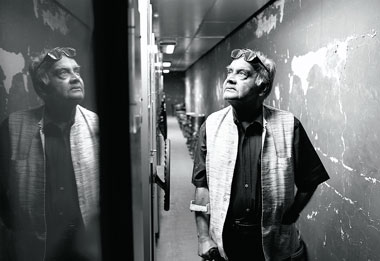
So P.K. Nair describes his relationship with cinema at the beginning of Shivendra Singh Dungarpur’s marvellous film, Celluloid Man (2012). Three years in the making, Dungarpur’s portrait of the legendary film archivist brings together stories from colleagues, filmmakers, students, friends and family, alongside the many hours spent interviewing Nair himself at home in Pune and at the National Film Archive of India, where he dedicated his life to preserving the prints that comprised India’s film heritage. Countless contributions from those influenced and inspired by Nair, assert his importance as a figure that worked tirelessly to ensure that cinema in India and the world would be preserved and that a passion and knowledge of filmmaking would be passed on to each new generation.

Dungarpur is himself the founder of the Film Heritage Foundation, which exists to support the conservation, preservation and restoration of the moving image, and having studied at the Film and Television Institute of India, he recognised Nair’s vital position at the centre of preserving film in India. The result of the director’s persistence in creating a portrait of Nair, is a film overflowing with insight, wit and enthusiasm for cinema, not just as a form of storytelling or art, but in its very physicality, as reels and cans are shown and discussed with enduring reverence.

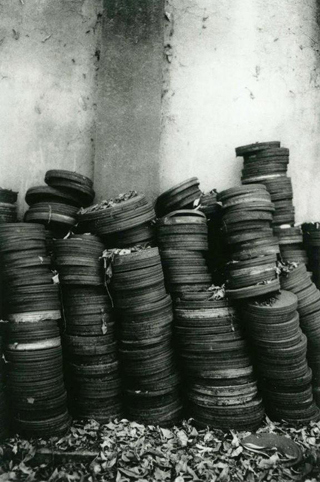
film-cans-storage-at-nfai-pune_Perhaps what is most fascinating – and poignant considering the digital age of exchange and sharing via download and streaming – are the stories relating to Nair’s acquisition of prints for the archive. Nair recalls that dozens of Russian films were donated, among them Battleship Potemkin and Alexander Nevsky, with no request for payment made; there’s also a story that he exchanged Pather Panchali for The Battle of Algiers and later Sant Tukaram for Hitchcock’s Blackmail with the British Film Institute. To hear of the exchange these films, told casually as though such traffic of prints is effortless, gives the impression that the creation of an archive is much like any process of collecting – where a community of enthusiasts survey their acquisitions for trading much like records, or marbles or cards. Yet Nair’s archive of prints were not kept hidden away – though it might be assumed that their preciousness would make them inaccessible to the public or students – instead we hear of how they were seen and used by everyone from eminent filmmakers to the villagers of Pune, as a nut farmer and a retired school teacher each recall fondly the pleasure of seeing Rashomon and Pather Panchali.

Dungarpur also interviewed Nair’s daughter, Beena, and it’s her recollection of childhood that is the most revealing aspect of Celluloid Man. To have dedicated so much of his life to cinema – complying with requests to view films even at 3am – it becomes apparent through Beena’s description that her father was not present in the home when she and her siblings were growing up. We hear that he would look forward to work, stay Iong hours and “not show any interest at all” in matters of the family. Beena describes how only when they matured, did they find common ground with their father and become close, developing the friendship that they cherish today. It’s in this testimony of the sacrifice of family life that one understands how dedicated Nair was to his work, confirmed in a later scene in which he describes moving back to Pune from Tivandrum following his wife’s passing because he felt that he must always be close to the film institute, recognising the archive as his true progeny.

“I think a person’s lifetime is too short a period to save all of the world’s film heritage,” so declares Nair, almost regretfully toward the end of Celluloid Man. Nevertheless it becomes apparent that this was his attempt, and in the appreciation of his peers and the audiences of the archive’s screenings, and of course Dungarpur’s own endeavour to document them, is evidence that his efforts have been appreciated, even if there will never be a person with the equivalent drive to continue his work.

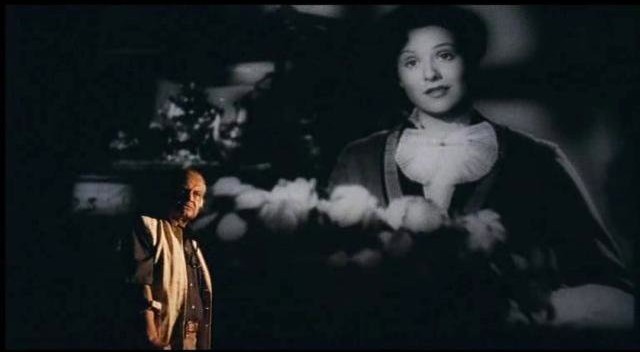
Celluloid Man_1A lasting image in Celluloid Man is that of Nair standing in front of the cinema screen quoting Citizen Kane as is its flickering image is projected behind him, framing his ageing stature. Here, Dungarpur presents Nair just as French archivist Henri Langlois is shown in Phantom of the Cinémathèque (Jacques Richard, 2004), standing before the cinema screen, describing how he wanted to show “shadows of the living coexisting with shadows of the dead.” Through Dungarpur’s carefully constructed portrait, this image reveals both men almost as if they have achieved that goal – of being immersed in cinema, of becoming inseparable from that which they love through the relentless activity of preserving its memory.

Celluloid Man is released by Second Run DVD and as ever, the accompanying special features are a treasure in themselves. An appreciation by filmmaker Mark Cousins demonstrates the reverence for P.K. Nair and the act of archiving to international film culture, whilst interviews and extracts from Dungarpur’s production diary are steeped in all the detail of realising the project, of particular pleasure – discovering the efforts made to ensure that the film could be shot on film, not digital – with a document of the ever decreasing stock of 16mm, which thankfully lasted to produce the gorgeous footage that truly does justice to the film’s subject.

View and re-view: some thoughts on The Sun in a Net

Fayolo (Marián Bielik) is, much like other examples of the cinematic photographer (Blow Up’s David Hemmings springs to mind) introduced as being somewhat distanced from the world around him. Seen in the company of the beautiful Bela (Jana Beláková) he admonishes her, as though her expression of personality runs contrary to the image of her he has created. Like all sensible fifteen year olds who have bigger problems than self-absorbed boys, Bela quickly splits from Fayolo, leaving him to dabble in both physical labour and the arms of the welcoming Jana (Ol’ga Ŝalagová). bscap0025je5Thus is a simple, teen-movie interpretation of The Sun in a Net’s (1962) plot – one omitting to mention the naturalistic portrayal of rural and urban life, family melodrama and expressionistic use of sound and music. Director Štefan Uher was a graduate of the Prague Film School (FAMU) in the mid 1950’s, and his subsequent work is considered key within the Czechoslovak New Wave, primarily The Sun in a Net – his second feature. Here Uher combines a formal vigour and innovative use of sound that is truly remarkable, with the question of what is seen and unseen of vital importance. Not only does the film present a central character who mediates the world through the lens of a camera, but the opening scenes use the drama of an eclipse to frame the initial characterisation – with characters seen using blacked-out glass through which to view the event – whilst Bela’s mother (Stana) – played with sensitivity by Eliška Nosálová – is also blind, relying on a descriptive interpretation of her surroundings, provided by her son and daughter. As the film makes clear, Bela’s mother is rendered doubly blind – both due to her impaired vision, and the modified versions of her environment that her children provide. Mirrors are also key, with both Stana and Bela framed within their reflections, suggesting the distorted image to be more primary than their actual selves.  Alongside this, the rhythmic, almost a-tonal music by Ilja Zeljenka punctuates Uher’s compositions, and a rock and pop soundtrack has a presence in scenes largely via radio transmissions, yet another instance of the medium being just as – (if not more) powerful as that which is heard. bscap0031ei4This focus on what are essentially forms of communication, gives depth and poignancy to a simple tale of teen passions, a tragic marriage and the concerns of the social and working lives of the Slovak people. By giving such prominence to media – the television aerials, the radio, even (to an extent) the narrative of working life Fayolo provides in written form to Bela – Uher presents a distinctly post-modern vision of Slovak life, and one which was clearly too provocative for the authorities at the time, who judged it unsuitable.

Once again Second Run DVD have brought another previously unreleased, yet vital cinematic work to our attention – and might I suggest that it be viewed as a double bill with Andrzej Wajda’s Innocent Sorcerers, made two years earlier in Poland, with no less an infectious and charismatic portrayal of youth, jazz and sex.