

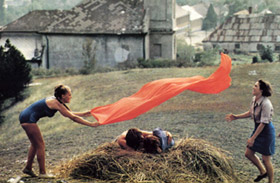
Fayolo (Marián Bielik) is, much like other examples of the cinematic photographer (Blow Up’s David Hemmings springs to mind) introduced as being somewhat distanced from the world around him. Seen in the company of the beautiful Bela (Jana Beláková) he admonishes her, as though her expression of personality runs contrary to the image of her he has created. Like all sensible fifteen year olds who have bigger problems than self-absorbed boys, Bela quickly splits from Fayolo, leaving him to dabble in both physical labour and the arms of the welcoming Jana (Ol’ga Ŝalagová).  Thus is a simple, teen-movie interpretation of The Sun in a Net’s (1962) plot – one omitting to mention the naturalistic portrayal of rural and urban life, family melodrama and expressionistic use of sound and music. Director Štefan Uher was a graduate of the Prague Film School (FAMU) in the mid 1950’s, and his subsequent work is considered key within the Czechoslovak New Wave, primarily The Sun in a Net – his second feature. Here Uher combines a formal vigour and innovative use of sound that is truly remarkable, with the question of what is seen and unseen of vital importance. Not only does the film present a central character who mediates the world through the lens of a camera, but the opening scenes use the drama of an eclipse to frame the initial characterisation – with characters seen using blacked-out glass through which to view the event – whilst Bela’s mother (Stana) – played with sensitivity by Eliška Nosálová – is also blind, relying on a descriptive interpretation of her surroundings, provided by her son and daughter. As the film makes clear, Bela’s mother is rendered doubly blind – both due to her impaired vision, and the modified versions of her environment that her children provide. Mirrors are also key, with both Stana and Bela framed within their reflections, suggesting the distorted image to be more primary than their actual selves. Alongside this, the rhythmic, almost a-tonal music by Ilja Zeljenka punctuates Uher’s compositions, and a rock and pop soundtrack has a presence in scenes largely via radio transmissions, yet another instance of the medium being just as – (if not more) powerful as that which is heard.
 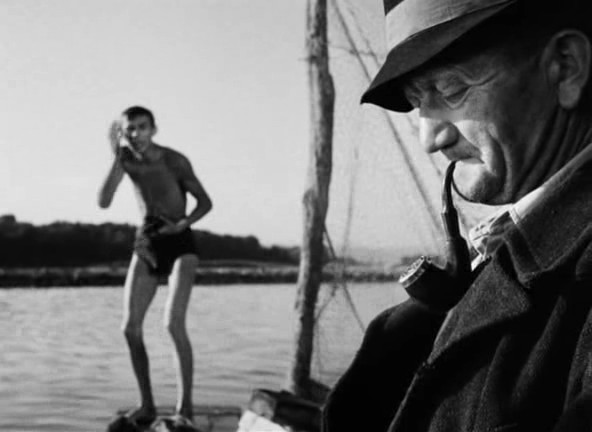 This focus on what are essentially forms of communication, gives depth and poignancy to a simple tale of teen passions, a tragic marriage and the concerns of the social and working lives of the Slovak people. By giving such prominence to media – the television aerials, the radio, even (to an extent) the narrative of working life Fayolo provides in written form to Bela – Uher presents a distinctly post-modern vision of Slovak life, and one which was clearly too provocative for the authorities at the time, who judged it unsuitable.
Once again Second Run DVD have brought another previously unreleased, yet vital cinematic work to our attention – and might I suggest that it be viewed as a double bill with Andrzej Wajda’s Innocent Sorcerers, made two years earlier in Poland, with no less an infectious and charismatic portrayal of youth, jazz and sex.



 cinematicinvestigations.com
