

This week, we approached another miss-matched couple with trepidation, but we were delighted to see Aniston playing football! Not only that, producing and starring in a flawed but endearing film.

FILM: Management
YEAR: 2008
DIRECTOR: Stephen Belber
CHARACTER NAME AND PROFESSION: Sue, commercial art dealer
PLOT SUMMARY: On a work trip to present to potential clients, Sue stays at a motel owned by Trish (Margo Martindale) and Jerry (Fred Ward). Their grown son, Mike (Steve Zahn, The Object of my Affection) also works at the motel. Mike is a socially awkward guy with little experience with women. He decides that Sue is the perfect woman for him based purely on ogling her when she checks in. The plot essentially involves Mike ingratiating himself into Sue’s life, despite her protests, following her across the country, uninvited. Somehow, perhaps out of sympathy, Sue finds Mike somewhat attractive and though she make clear he has violated boundaries, something compels her not to turn him away. Eventually, their lives take different paths, but Mike remains persistent. They both challenge each other to live with more care for themselves. Also Woody Harrelson plays Sue’s lover, an ex-punk called Jango.

CHARACTER TRAITS: Generous, charitable, kind, confident, self-posessed (to a point), assertive. Claims not to be a ‘people person’.
NOTES ON PERFORMANCE: The plot of Management is so creepy on paper – socially awkward man stalks woman persistently, demanding affection like a puppy – that initially it’s hard to see how the filmmakers are going to pull this off. That the film is watchable, thoughtful and occasionally funny, is due to Aniston’s well observed and hugely affecting performance. She presents Sue as someone at once at ease with, and slightly outside of her experience of the world. That she makes believable Sue’s resistance and curiosity about Mike is a great accomplishment. One scene in particular really showcases, with tremendous subtlety, how connected Aniston is to her character: after Mike travels to her hometown, Maryland, on a one-way ticket, Sue reluctantly spends time with him but naturally sends him home on the bus. When they part, Mike leans in to kiss Sue’s cheek, and in this moment, Aniston’s micro expressions convey the full range of Sue’s feelings – concern, affection, anxiety, sadness – which demonstrate her internal world and some of the reasons why she’s tolerating Mike. The moment is crucial in persuading the audience to believe in this ‘odd couple’ and Aniston nails it.

NOTES ON FILM: Writer/Director Stephen Belber is also a successful playwright, and is notable for writing both the stage and screenplay for Richard Linklater’s Tape (2001), a work that relies on each character’s changing perception of the other as slowly, truth is revealed. With Management, though the plot really, really pushes credibility (the skydiving?! Mike becomes a monk?!), it’s again the characters changing perception of each other that carries the film. Despite all its flaws, Belber’s (mainly) emotionally intelligent screenplay and the sheer force of Aniston and Zahn’s performances, make the relationship here, somehow believable.
CONCLUSION: Aniston produced this also, and her belief in the film is obvious. She’s triumphant.




 Sean Baker’s Tangerine has been widely praised and discussed since its world premiere at Sundance in January. Shot using an iPhone 5 in West Hollywood, the film follows trans sex workers Sin-Dee (Kitana Kiki Rodriguez) and Alexandra (Mya Taylor) around LA over the course of one day – Christmas Eve – while Sin-Dee attempts to confront her boyfriend Chester (James Ransone) for cheating on her with a cis-gendered woman. The film is remarkably cinematic, due to Baker and co-cinematographer Radium Cheung’s discovery of an anamorphic adapter for the iPhone that allowed them to shoot in scope. Assumptions about a film shot with a phone are quickly dispelled as wide roof-top shots and street scenes open up the film’s setting and capture the character’s sprawling environment.
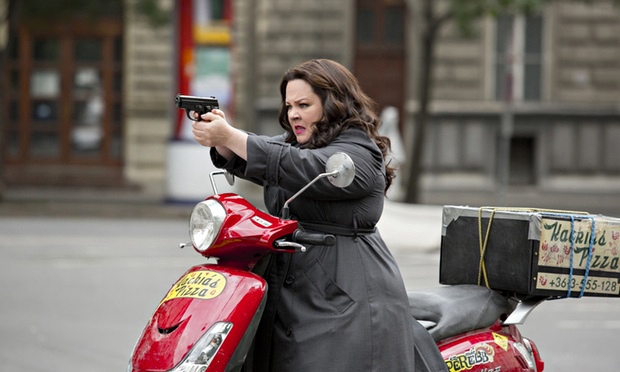 Other films viewed this week include two starring Melissa McCarthy, one a re-watch of Bridesmaids, and another Paul Feig helmed comedy, Spy, which also stars Miranda Hart and Jude Law. McCarthy plays Susan Cooper, a desk-based CIA agent usually guiding Law’s active spy Bradley Fine through his covert operations via an ear piece. When disaster strikes, Susan offers to go into the field herself, assuming her lack of experience will make her less of a target for the agencies enemies. McCarthy is reliably hilarious, and there’s some sharp observations of workplace sexism in the way her character is frequently assigned aliases that reinforce stereotypes about a person of Susan’s size, age and gender. Jason Statham, is given ample opportunity to ape his Transporter-like persona, throwing out boastful lines attesting to his strength and indestructability with an almost insatiable frequency. That McCarthy is very a dramatic, comedic and action star here is immensely enjoyable, even if spy spoofs bring with them their own clichés.
 cinematicinvestigations.com