Aniston of the week began ten films ago with Tiffanie DeBartolo’s 1996 comedy Dream for An Insomniac. So, what have we learned?
According to the Aniston Role Matrix (which I just mocked up today), we’ve seen performances over three decades: five of Aniston’s nineties and early noughties Friends era movies, two in the late noughties and three from this decade. Aniston has played two health care professionals, and two creative characters. Most frequently I’ve used the word ‘kind’ to describe her characters, but also ‘low self-esteem’ and ‘assertive.’
The kind roles tend towards the Rachel times, whilst recently, Aniston has played more prickly or unethical characters. In interviews, particularly for Horrible Bosses, Aniston has spoken about how she is rarely considered for such roles, so having the opportunity is both a challenge and a great deal of fun.
We’ve seen Aniston in only two films directed by women. Five of her roles have been in romantic comedies, six have paired her with a male lead, two have been ensemble comedies and in one, she’s the supporting player. It’s perhaps too early to make a full assessment, but a good time to get an insight into Aniston’s attitude and approach to acting. Here’s her appearance on Inside the Actors Studio, in which she mainly gives short answers and uses comedy to deflect any deeper probing. Rather than an evasion tactic, it perhaps shows her as she describes herself, ‘silly’ and ‘goofy’ and ‘not taking myself too seriously.’
Last year, I participated in International Film Festival Rotterdam’s Trainee Programme for Young Film Critics. It was my first visit to a film festival outside the UK and it opened up a world of cinema I’d yet to see at that point. Going back this year has been a very different experience, not least of all for navigating the programme without the structure of jury screenings to attend. When faced with a programme as massive as IFFR’s, it can be daunting to know what to see. I took the opportunity to see some celebrated work by established directors (Ben Rivers, Lucille Hadzihalilovic, Laurie Anderson, and Whit Stillman) and was drawn to new work by female filmmakers considering issues of representation, compliance, gender, and sexuality.
Melisa Liebenthal’s Las Lindas, which had its world premiere screening in the Bright Future section, is an autobiographical essay film, focused on her adolescence and that of her friends, how they developed into young women and the societal expectations they felt to be attractive.
Las Lindas (The Pretty Ones)
Chronicling the shifting loyalties among her school friends, Liebenthal explains how, between the ages of 9-12, she and her friend Camilla were very close, slightly apart from a group of girls they would later bond with, who referred to themselves as the ‘Little She Stars.’ The ‘Stars’ were popular, confident and close with the boys from their class. By contrast, Liebenthal states that, ‘at the age of 12 I decided to stop smiling in photographs.’ A montage of pictures attests to this, with Liebenthal seen at the beach, or a museum or with family, each time with the same half blank, half serious expression. The smile is this director’s first target for critiquing the conditioning of young women to be compliantly attractive to men. “You’re prettier if you smile” – and other persuasion tactics – are here identified as absurd but extremely effective manipulations, seen in the countless photos of smiling girls shown, that contrast with Liebenthal’s straight-faced rebellion.
The young Melisa Liebenthal
It’s an entertainingly frank, clear and witty self-portrait that neatly places the filmmaker’s own experience within the context of wider issues around gender inequality, relying more on personal testimony than statistics or academic theory. Liebenthal’s willingness to expose her own insecurities, her inviting self-awareness, combined with editor Sofia Mele’s efficient handling of each sequence, make Las Lindas not just a film every teenager should see, but a thoughtful and worthy contribution to the essay-film genre.
Actor Martinez l-r: Mike Ott, Arthur Martinez, Lindsay Burdge, Nathan Silver
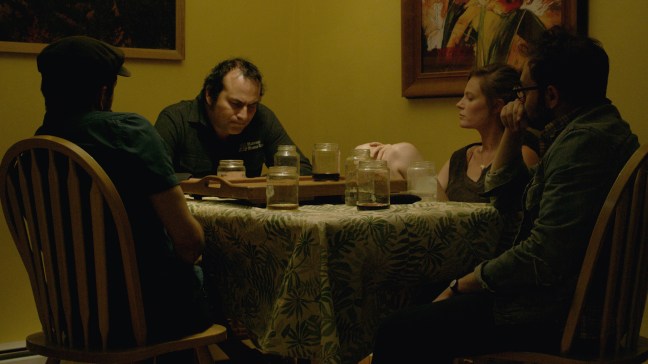
In five years, prolific American director Nathan Silver has made six feature films and five short films. I saw Stinking Heavenat IFFR last year, where the director has been well featured over the years. That film looked at the use of role play as therapy in a communal living situation, and with his new work, Actor Martinez, Silver has teamed up with co-director Mike Ott, to take the concept of role play as far as possible. Seen in the film as themselves – or versions of themselves – Ott and Silver follow actor/full time computer repairman, Arthur Martinez as he goes about his daily life; you might call such scenes documentary. Arthur also performs as himself in scenes constructed by Ott and Silver, and the three of them hold auditions for the part of Arthur’s love interest. Actor Martinez frequently works with set ups and reveals, between what is presented as ‘document’ and what is play, even its two directors set up scenes where they read lines as themselves, playing almost Machiavellian overlords to Arthur’s life. The latter complains consistently that the experience is ruining his life, and that he no longer knows what is real and what is play, and appears to evade revealing his ‘true’ self to his tormentors, who, frustrated, push the limits of what is tolerable not only for Arthur, but for his co-star, Lindsay Burdge. What is ultimately ‘actual’ and what is constructed remains a puzzle that Ott and Silver clearly want their audience to enjoy trying to solve.
Maggie Siff in A Woman, A Part
Also interested in role play, is Elisabeth Subrin’s A Woman, A Part, which had its world premiere at the festival. Maggie Siff (Mad Men, Sons of Anarchy) plays Anna Baskin, an actor who takes an abrupt leave from her successful TV role to go back to her old apartment in New York. There she meets up with two friends with whom she once collaborated in the ‘90s; Kate (Cara Seymour, American Psycho, The Knick) who is less than happy to see her, and Isaac (John Ortiz, Silver Linings Playbook) who welcomes her, but isn’t altogether honest. The three friend’s fractured relationship then becomes the film’s focus, with as much time spent on Kate’s internal struggles – showcasing Seymour’s incredible performance – as Anna’s journey back to stability. A Woman, A Part is perhaps flawed in not allowing enough of the comic moments its cast are clearly capable of delivering, but it’s refreshing to see an adult drama where the protagonist’s lives feel authentically written, they have real flaws, which mean you can’t like them all the time. Each of them is still trying to find their role, and seeing the process of them push each other is often very thoughtfully done. Still, the ending is perhaps too neat for all that’s gone before.
Wild
I saw two very different approaches to female sexuality in Nicolette Krebitz’s Wild and Anna Biller’s The Love Witch. In the former, writer/director Krebitz extracts a compelling performance from her lead, Lilith Stangenberg as Ania, a young woman who one day sees a wolf in the woods near her apartment and becomes obsessed with capturing it. Much is made of Ania’s sad and repetitive life, and her introverted personality, enhanced by a palette of grey blue and her somewhat girlish clothes, all the more to demonstrate the change that affects her when she and the wolf become housemates. There’s a level of absurdity to some sequences, notably when Ania’s sexual fantasies play out, but this seems to come more from a knowing sense of humour than unintentional clumsiness. Stangenberg’s performance remains one of conviction, and very much carries the film to its inevitable conclusion. Krebitz is playing with the theme of the instinctual, wild woman supressed by the expectations of the patriarchy, and she does so with a kind of gleeful wickedness that is actually, a lot of fun.
Samantha Robinson as Elaine and Jeffrey Vincent Parise as Wayne in The Love Witch
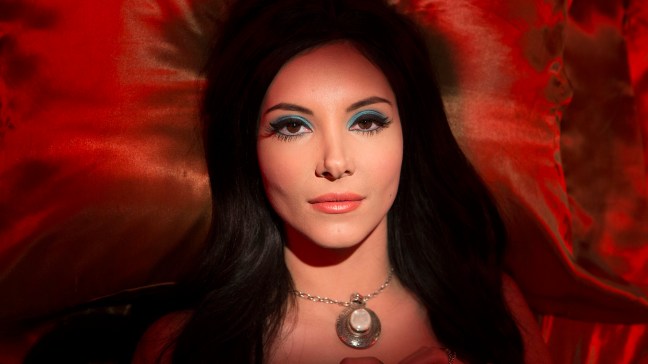
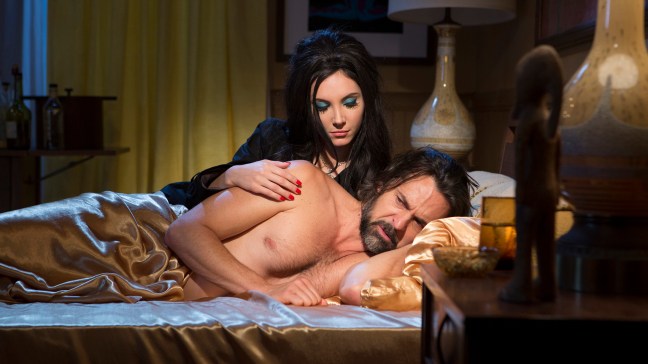
Fun, also is The Love Witch in which writer/director/editor/producer Anna Biller (who also did production and costume design) has created a present-day scenario where young lovelorn witch Elaine (Samantha Robinson) is intent on embodying the ultimate male sexual fantasy. Using the aesthetics of 1960s sexploitation cinema and shot on 35mm, Biller envelopes the viewer in a completely realised, technicolour world, at once removed from, and inherently familiar as, ‘real’. Real in the sense that Elaine’s entirely constructed femininity, functioning to give pleasure to the men she gives her love potion to, is only a slight exaggeration from the everyday standard of beauty with which women are still conditioned to comply, as is demonstrable from Las Lindas.
Elaine with Laura Waddell as Trish in The Love Witch
Despite Elaine’s layers of artificiality and obliviousness, Biller is sympathetic to her brainwashed central character, making clear that it’s the men in her life who have led her to follow this path, and who will, finally and tragically, oppose her. Along the way, the sheer beauty and level of attention to detail in The Love Witch is stunning, and Robinson’s performance shows an astonishing commitment to the physicality of the role, which requires great restraint and poise (utilising her background in dancing). The Love Witch was a particular highlight of IFFR 2016 – a gloriously seductive feminist work, and a distinctly pleasurable viewing experience.
Also seen: Heart of a Dog, Laurie Anderson The Sky Trembles and the Earth is Afraid and the two Eyes are not Brothers, Ben Rivers A Woman, A Part, Elizabeth Subrin Strange Love, Natasha Mendonca Love & Friendship, Whit Stillman Evolution, Lucille Hadzihalilovic Sixty Six, Lewis Klahr History’s Future, Fiona Tan Arianna, Carlo Lavanga
This week, we approached another miss-matched couple with trepidation, but we were delighted to see Aniston playing football! Not only that, producing and starring in a flawed but endearing film.
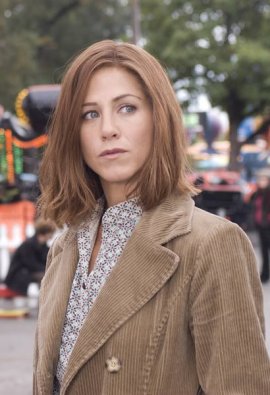
Aniston feels our trepidation
FILM: Management
YEAR: 2008
DIRECTOR: Stephen Belber
CHARACTER NAME AND PROFESSION: Sue, commercial art dealer
PLOT SUMMARY: On a work trip to present to potential clients, Sue stays at a motel owned by Trish (Margo Martindale) and Jerry (Fred Ward). Their grown son, Mike (Steve Zahn, The Object of my Affection) also works at the motel. Mike is a socially awkward guy with little experience with women. He decides that Sue is the perfect woman for him based purely on ogling her when she checks in. The plot essentially involves Mike ingratiating himself into Sue’s life, despite her protests, following her across the country, uninvited. Somehow, perhaps out of sympathy, Sue finds Mike somewhat attractive and though she make clear he has violated boundaries, something compels her not to turn him away. Eventually, their lives take different paths, but Mike remains persistent. They both challenge each other to live with more care for themselves. Also Woody Harrelson plays Sue’s lover, an ex-punk called Jango.
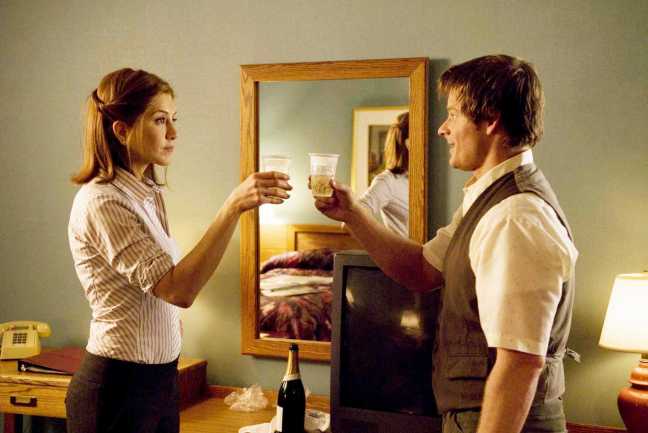
Aniston with Steve Zahn as Mike
CHARACTER TRAITS: Generous, charitable, kind, confident, self-posessed (to a point), assertive. Claims not to be a ‘people person’.
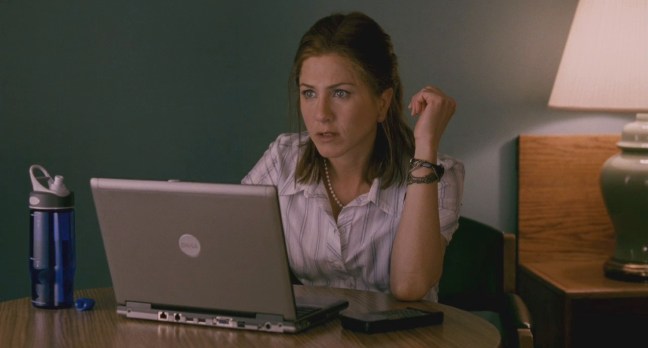
NOTES ON PERFORMANCE: The plot of Management is so creepy on paper – socially awkward man stalks woman persistently, demanding affection like a puppy – that initially it’s hard to see how the filmmakers are going to pull this off. That the film is watchable, thoughtful and occasionally funny, is due to Aniston’s well observed and hugely affecting performance. She presents Sue as someone at once at ease with, and slightly outside of her experience of the world. That she makes believable Sue’s resistance and curiosity about Mike is a great accomplishment. One scene in particular really showcases, with tremendous subtlety, how connected Aniston is to her character: after Mike travels to her hometown, Maryland, on a one-way ticket, Sue reluctantly spends time with him but naturally sends him home on the bus. When they part, Mike leans in to kiss Sue’s cheek, and in this moment, Aniston’s micro expressions convey the full range of Sue’s feelings – concern, affection, anxiety, sadness – which demonstrate her internal world and some of the reasons why she’s tolerating Mike. The moment is crucial in persuading the audience to believe in this ‘odd couple’ and Aniston nails it.
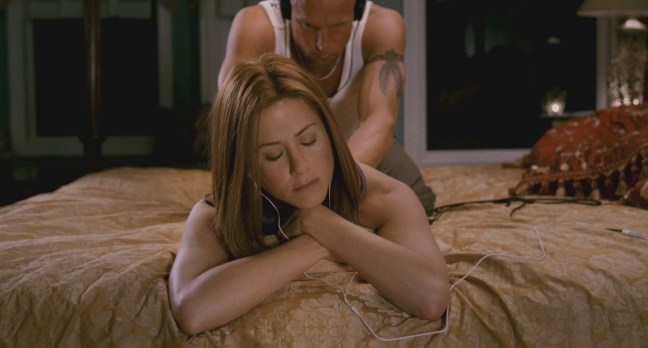
Nothing like receiving a massage whilst the two of you listen to music via headphones (?!)
NOTES ON FILM: Writer/Director Stephen Belber is also a successful playwright, and is notable for writing both the stage and screenplay for Richard Linklater’s Tape (2001), a work that relies on each character’s changing perception of the other as slowly, truth is revealed. With Management, though the plot really, really pushes credibility (the skydiving?! Mike becomes a monk?!), it’s again the characters changing perception of each other that carries the film. Despite all its flaws, Belber’s (mainly) emotionally intelligent screenplay and the sheer force of Aniston and Zahn’s performances, make the relationship here, somehow believable.
CONCLUSION: Aniston produced this also, and her belief in the film is obvious. She’s triumphant.







 cinematicinvestigations.com